

James Sanson
Lead Short Sale Negotiator
Licensed since August 2002, Maricopa focus since 2004. Handles every short sale on this site personally.
Lead Short Sale Negotiator
Licensed since August 2002, Maricopa focus since 2004. Handles every short sale on this site personally.

Buyer Specialist
7 years in Maricopa. Works with buyers writing offers on our short sale listings. Patient, thorough, answers the phone.

Bilingual Buyer Specialist
Habla espanol. 8 years experience. Works with buyers across 85138 and 85139 on our short sale listings.
The week-by-week walkthrough of what gets done, who does it, and when you can expect updates from us and from your lender.
Real Broker LLC · Licensed in Arizona
A Maricopa short sale moves from listing to closing through seven milestones: listing day; showings and offers; offer accepted and submitted to the lender; BPO and underwriting; approval letter; escrow and final preparations; and closing day. Total elapsed time is typically 90 to 180 days. The seller's biggest active windows are during listing prep, showings, and the weeks leading up to closing. The middle phase is mostly waiting on the lender.
In this guide
A Maricopa short sale is not a single event. It is a series of milestones that unfold over three to six months, with the seller more or less actively involved at different points. This page walks through the full arc from listing day to closing day, what happens at each milestone, what the seller does at each step, and what to expect between milestones. The goal is to take away the uncertainty about what comes next.
For a step-by-step look at the underlying process, see the full short sale process. For specific timing details, see how many months a short sale takes. Call 520-838-8037 if you want to talk through your situation directly.
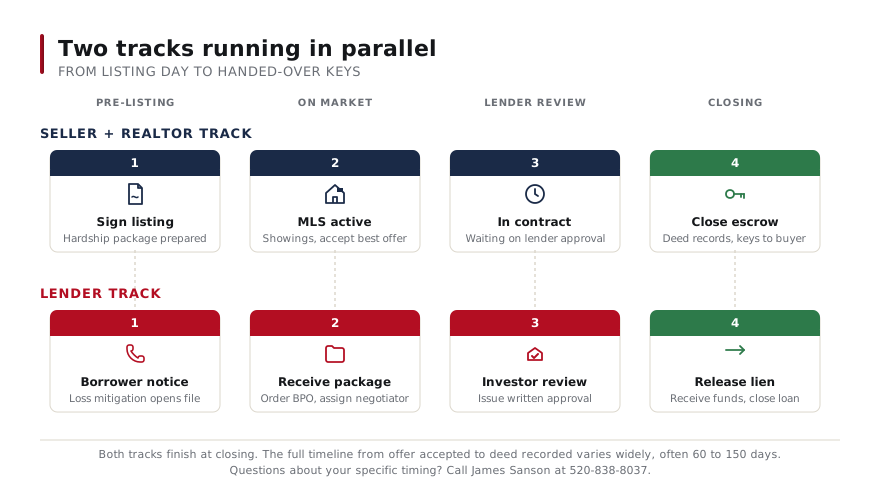
Listing day is when your property officially goes on the market. The MLS listing is activated, the required short-sale disclosures appear in the listing remarks, the photos are live, and marketing begins. From this day forward, the property will be shown, and offers can be made at any time.
Most of the seller's preparation work happens before this day, not after. By the listing day, you should have your hardship documentation organized, the home in showing condition, and basic decisions made about access and lockboxes. The day itself is largely passive on your end. The listing is now working for you.
What you should plan for after listing day: keeping your daily living space tidy, getting out for showings on short notice when possible, and being available by phone when our team reaches you about offer activity or questions.
This phase runs from listing day until you have an acceptable offer in hand. In the typical Maricopa short-sale market, the showings phase lasts 2 to 8 weeks. Well-priced properties in good condition move faster. Properties priced above the lender's expected value, or those needing repairs, take longer.
During this phase, showings occur according to the buyer agent's schedule. We coordinate scheduling with you. Most short sale showings are by appointment with at least a few hours' notice, but occasionally same-day requests come in, and the more flexibility you offer, the more buyers see the home. Open houses are sometimes used; we discuss whether one makes sense for your property.
Offers come in either through buyer agents or directly. Each offer is evaluated for both seller-friendliness and lender-likelihood-of-approval. A high-priced offer with weak buyer financing is often worse than a slightly lower offer with strong financing. We screen with the eventual lender review in mind. The arc through this phase mirrors patterns you can also see in your Maricopa neighborhood for comparable market activity.
Once you accept an offer, the complete short-sale package is sent to the lender's loss mitigation department. The package includes your hardship documentation, financial records, the executed purchase contract, the buyer's proof of funds or pre-approval, the listing agreement, and a preliminary settlement statement. For the full list of items that go in, see the required short sale paperwork.
The day the package is submitted is the moment the lender's clock starts. From this point until the approval letter arrives, you are mostly waiting. Some lenders use proprietary submission portals (Equator is a common one); others use email or fax. Whichever method applies, we follow up to confirm receipt and that the file has been assigned to a loss mitigation negotiator.
Within a few weeks of submission, the lender orders an independent valuation. For most short sales, this is a Broker Price Opinion (BPO) performed by a local Realtor the lender contracts with. For some loan types and higher-value properties, the lender orders a full appraisal instead. Either way, the BPO inspector will need access to the property. Showings during this window are normal, and we coordinate scheduling.
After the valuation, loss mitigation underwrites the deal. They verify hardship documentation, financial picture, buyer credibility, and the proposed net to the lender. This combined BPO-and-underwriting phase runs 60 to 120 days. It is the longest single phase of the short sale, and the one where homeowners feel most in the dark. We provide regular updates through this window. For a deeper look, see Getting Your Lender to Approve a Short Sale.
The approval letter is the document that confirms the deal will close. It specifies the minimum net the lender will accept from the sale, the closing deadline, the buyer of record, any required seller contribution or promissory note, and any other conditions. Most approval letters are valid for 30 to 60 days.
Counters are common before the final approval. The lender may want a higher price, a seller contribution, or modified terms. We respond on your behalf within the counter response window and tell you up front which terms are negotiable and which are fixed by investor guidelines. Once both sides agree on terms, the approval letter is issued.
From the seller's perspective, receiving the approval letter is the emotional turning point of the entire process. The deal is now reasonably stable, and the path to closing is clear. The remaining work is logistical, not approval-related.
Once the approval letter is in hand, the deal moves into escrow on a standard real estate closing track. The buyer finishes loan underwriting (or wires funds, if cash), the title company prepares closing documents, inspections wrap up, and a closing date is set. Cash buyers can close in two weeks. Financed buyers typically need four to six weeks.
This is when most sellers complete their move. The approval letter's closing deadline gives a target date. If you have not started packing, this is the window. We coordinate with the title company on signing logistics and walk you through any documents that come from escrow before signing day.
If the buyer's financing falls through during escrow (it happens, especially on long deals that test patience), the deal can be replaced. The listing reactivates, marketing resumes briefly, a new offer comes in, and the lender's prior review work usually transfers. The second submission tends to move faster than the first.
Closing day is the formal transfer of the property. You sign the final paperwork at the title company or via mobile notary, the deed transfers to the buyer, the buyer's funds and lender's payoff are routed by the title company, and the property records with the county. From your perspective, the day involves perhaps an hour of signing and the formal handoff of keys.
What you receive at closing depends on what the approval letter says. Most short sales net zero to the seller (the proceeds go entirely to the lender, with closing costs deducted). Some loan programs include a small seller incentive (FHA Pre-Foreclosure Sales sometimes do). For a detailed walk-through of the final hours, see what happens at a short sale closing.
After closing, the deficiency (if any) is handled according to the approval letter terms. If the lender waived the deficiency, the loan is satisfied in full, and you have no further obligation. If a promissory note was part of the approval, repayment terms begin per the note. Either way, the property is no longer yours, and the short sale is complete.
The seven milestones above describe the typical arc, but short sales sometimes deviate. The most common deviations are buyer changes (the original buyer walks and a new one is found), counter-negotiations that extend the lender review, and BPO disputes when the valuation comes in unexpectedly high. None of these is unusual, and none usually ends the deal.
Other circumstances change the picture more substantially. If a Notice of Trustee Sale arrives partway through, the foreclosure clock interacts with the short sale clock, and we may need to escalate to the lender to request a pause. If your financial situation changes mid-process (a job offer comes through or a settlement arrives), the hardship case may need to be updated. If life logistics shift (e.g., a relocation date moves up), the closing window may need to be negotiated.
The short sale arc is more flexible than it looks from the outside. The structure exists, but most milestones have some give. The earlier you flag a change in circumstances, the more we can work with it. For a broader context on whether a short sale is still the right path versus other options, see the difference between a short sale and foreclosure, and consider selling an underwater home when making related decisions.
The questions below come up regularly as Maricopa sellers move through the milestones. For impartial guidance from outside our team, you can request a HUD-approved housing counselor at no cost. To talk through your situation directly, reach out to Maricopa short sale Realtors. Call 520-838-8037 to get started.
Last reviewed May 15, 2026, by James Sanson, REALTOR. We review this guide regularly and update it to reflect changes in lender procedures, escrow practices, and Maricopa market conditions.
No pressure, no obligation, no charge. James will call you back personally to discuss your options. For faster help, call 520-838-8037.
James personally handles every short sale on this site. David Hoos and David Ruiz are buyer specialists who help when our short sale listings need buyers.
Listing Specialist, Lead Short Sale Negotiator
Licensed Arizona REALTOR since August 2002, focused on Maricopa since 2004. 1,000+ closings. Built the short sale practice during the 2008-2012 downturn. Personally manages every short sale file on this site.
Buyer Specialist
7 years in Maricopa. Works with buyers, including those writing offers on our short sale listings. Patient, thorough, answers the phone.
Bilingual Buyer Specialist
Habla espanol. 8 years experience. Works with buyers across 85138 and 85139, including those writing offers on our short sale listings.
Whether you're buying, selling, or just exploring, call us. No obligation.
520-838-8037James Sanson | Real Broker LLC | Licensed in Arizona
Call 520-838-8037 right now, or fill out the form and we will reach out within one business day.