

James Sanson
Lead Short Sale Negotiator
Licensed since August 2002, Maricopa focus since 2004. Handles every short sale on this site personally.
Lead Short Sale Negotiator
Licensed since August 2002, Maricopa focus since 2004. Handles every short sale on this site personally.

Buyer Specialist
7 years in Maricopa. Works with buyers writing offers on our short sale listings. Patient, thorough, answers the phone.

Bilingual Buyer Specialist
Habla espanol. 8 years experience. Works with buyers across 85138 and 85139 on our short sale listings.
From loan modification to short sale to deed in lieu: what each path actually means, and how to decide which one fits your specific situation.
Real Broker LLC · Licensed in Arizona
If you are facing foreclosure in Maricopa, AZ, you have five main paths to consider: loan modification, short sale, deed in lieu of foreclosure, reinstatement or forbearance, and bankruptcy. Each fits different situations. Before choosing one, call a free HUD-approved housing counselor at hud.gov or a licensed Arizona attorney. They can review your full situation without trying to sell you anything. If a short sale is the right fit, the James Sanson Team has guided Maricopa homeowners through this process since 2004. Call 520-838-8037 for a confidential conversation.
If you have fallen behind on your Maricopa mortgage or already received a Notice of Default, this page is for you. The first thing to understand is that pre-foreclosure is a window of time, sometimes a short window, where decisions you make now can significantly affect your outcome. You are not out of options. You do need to act before that window closes.
This page walks through every legitimate option available to a Maricopa homeowner in pre-foreclosure, what each one entails, and how to figure out which one fits your situation. Before anything else, consider calling a free HUD-approved housing counselor at hud.gov. They are neutral, federally funded, and not trying to sell you anything. If you want to talk through whether a short sale fits, call 520-838-8037. The James Sanson Team has helped Maricopa homeowners through this since 2004.
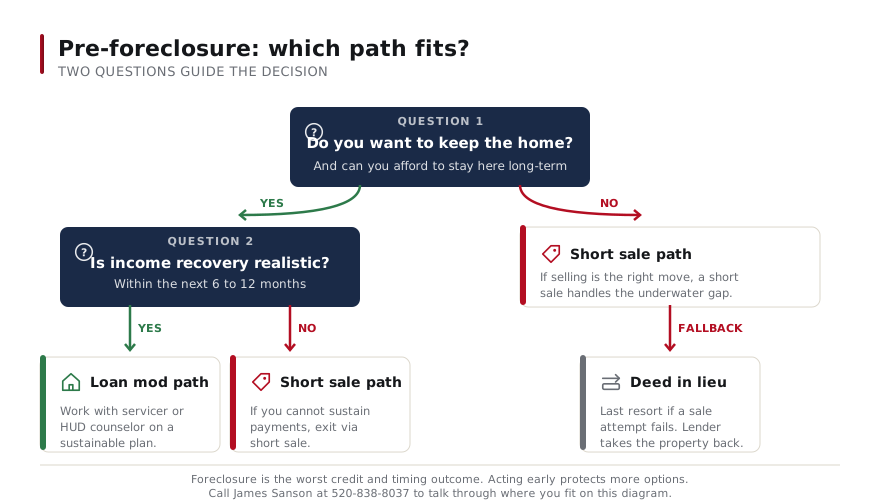
"Pre-foreclosure" is the period between when you fall behind on your mortgage and when the trustee sale actually occurs. It is not a single status. It is a sequence of stages, and your options change at each one.
In Arizona, the typical stages are:
The earlier in this sequence you are, the more options you have. The closer to the trustee sale date, the harder things get. That is not meant to scare you, just to be straight about how Arizona's non-judicial foreclosure process works.
Arizona is a non-judicial foreclosure state, which means foreclosure here moves faster than in states that require a lawsuit and court ruling. For most Maricopa homeowners, the total timeline from first missed payment to trustee sale runs roughly 110 to 180 days. The biggest variable is your lender, not Arizona law.
Some loan types, particularly FHA and VA loans, have additional federally required pre-foreclosure steps that may extend the timeline. Some servicers move faster than average. If you have a second mortgage, an HOA lien, or other complications, the timeline can be compressed or extended in various ways.
For a detailed walkthrough of the day-by-day sequence and what you can still do at each stage, see the Arizona foreclosure timeline. The single most important thing is not to wait. Every option below works better with time on your side. If you are unsure where you are in the timeline, call 520-838-8037, and we can talk it through with you.
A loan modification permanently changes the terms of your existing mortgage so that future payments are affordable. The modification might lower the interest rate, extend the loan term, capitalize past-due amounts into the new balance, or some combination. The original loan does not get refinanced. It gets restructured.
Loan modification can be the right path when:
Loan modification is negotiated between you and your lender's loss mitigation department, often with the help of a HUD-approved housing counselor. Your Realtor is generally not the right person for this. James does not negotiate loan modifications. If you think a modification may fit, the right starting points are your servicer's loss mitigation department and a HUD counselor. For a direct comparison between this path and a short sale, see comparing loan modification to short sale.
A short sale is the sale of your home for less than you owe on the mortgage, with your lender's permission. The lender agrees to accept the sale proceeds as satisfaction of the debt, even though the proceeds will not cover the full balance. The home is sold, you move on, and the deficiency is typically forgiven (subject to lender terms and Arizona anti-deficiency statutes).
A short sale is often the right path when:
This is the path the James Sanson Team handles directly. We have walked Maricopa homeowners through short sales since 2004, including through the 2008 to 2012 downturn, when short sales were the default exit for many distressed sellers. For the full walkthrough of how a short sale works in Arizona, see the Maricopa short sale process. To talk through whether your situation fits, call 520-838-8037.
A deed in lieu of foreclosure is a voluntary transfer of the property's deed back to the lender in exchange for release from the mortgage debt. You give the lender the home. The lender takes the property without going through a trustee sale. The mortgage is satisfied.
Deed in lieu can fit when:
Deed in lieu is not always available. Many lenders require you to attempt a short sale first. Second mortgages, HELOCs, and judgment liens can block it because the senior lender taking the deed does not extinguish junior liens. For a side-by-side comparison with a short sale, see short sale vs deed in lieu. If a deed in lieu has been suggested to you and you want a second opinion, call 520-838-8037 before you sign anything.
Reinstatement means paying the full past-due amount, plus accumulated fees and costs, in one lump sum. This brings the loan current and stops the foreclosure track entirely. It works for homeowners who fell behind temporarily and have since recovered the funds.
Forbearance is a temporary agreement with your lender to pause or reduce payments for a set period, usually due to a short-term hardship such as a medical emergency or temporary job loss. At the end of the forbearance period, the missed amounts come due, typically through a repayment plan or by adding the arrears to a modified loan.
Both options work best when:
Reinstatement and forbearance are negotiated directly with your servicer's loss mitigation department. A HUD-approved housing counselor can help you build a strong application. James does not handle this; this is between you and your lender.
Filing Chapter 7 or Chapter 13 bankruptcy triggers an automatic stay under federal law that immediately halts foreclosure proceedings. Chapter 13, in particular, can allow you to catch up on past-due mortgage payments over a three- to five-year repayment plan while keeping the home.
Bankruptcy is a major legal decision with broad and lasting consequences for credit, future borrowing, and other assets. It should only be considered after consulting a bankruptcy attorney licensed in Arizona. The James Sanson Team does not advise on bankruptcy. If you are considering it, speak with a bankruptcy attorney before making any other decisions about the home. Many Arizona bankruptcy attorneys offer free initial consultations.
Doing nothing and letting the home foreclose is technically an option. In most cases, it is also the worst outcome among the paths listed on this page.
Compared to a short sale, a completed foreclosure typically results in:
This is not universally true. In some specific circumstances, particularly where you have already missed the window for a successful short sale, the alternatives may be more appropriate than continuing to try to sell. That is exactly the kind of question a HUD counselor or an Arizona attorney can help you sort through. For a direct comparison of these two specific paths, see short sale or foreclosure.
A short sale does affect your credit, but typically less severely than a completed foreclosure. The missed payments leading up to the short sale are reported, which can lower your score. The short sale itself appears on your credit report as a "settled for less than full balance" or similar notation, depending on how the lender reports.
The recovery period after a short sale is generally shorter than after a foreclosure. Many short sale sellers can qualify for a new mortgage within two to four years, depending on the loan program (FHA, VA, USDA, and conventional all have different waiting periods and seasoning requirements).
For a detailed breakdown of credit impact, score recovery, and re-qualification timing, see how a short sale affects your credit. For tax questions about forgiven mortgage debt, consult a licensed CPA, since federal tax treatment can vary based on your specific circumstances and current law.
If you take only one piece of advice from this page, take this one: before you commit to any of the options above, call a HUD-approved housing counselor. They are non-profit, funded by federal grants (so the service is free to you), and they have no commission or fee structure that would push you toward any particular outcome.
A HUD counselor can:
For more on when it makes sense to reach out in your situation and what to expect from the conversation, see when to talk to a HUD counselor. You can find a HUD-approved housing counselor in Arizona or call the HUD helpline at 1-800-569-4287. Many counselors serve Arizona by phone, and many speak Spanish. The Consumer Financial Protection Bureau mortgage help resources also list legitimate help options.
If, after talking to a HUD counselor, you conclude that a short sale fits, then calling 520-838-8037 makes sense. The James Sanson Team handles listing, marketing, and lender negotiation for short sales. We do not advise on loan modifications, bankruptcy, or broader legal strategy. For those questions, the HUD counselor or an Arizona-licensed attorney is the right professional.
Important.This page describes typical pre-foreclosure options for Maricopa homeowners for educational purposes. Your specific situation may have legal, tax, or financial dimensions that require professional advice. For legal questions, consult an Arizona-licensed attorney. For free, neutral mortgage assistance counseling, contact a HUD-approved counselor at hud.gov. Each option above is subject to lender approval, eligibility requirements, and conditions that vary by situation. No outcome can be promised.
If you want to think through where you stand and which option might fit your specific situation, call 520-838-8037. We will listen, explain what a short sale would look like for you, and refer you to other professionals (HUD counselors, attorneys, CPAs) if a different path is a better fit. There is no cost to talk, no obligation, and no pressure. You can also explore related topics like options when payments are too much if you are not sure where to start. Our Maricopa short sale specialists have walked Maricopa homeowners through pre-foreclosure for over two decades.
No pressure, no obligation, no charge. James will call you back personally to discuss your options. For faster help, call 520-838-8037.
James personally handles every short sale on this site. David Hoos and David Ruiz are buyer specialists who help when our short sale listings need buyers.
Listing Specialist, Lead Short Sale Negotiator
Licensed Arizona REALTOR since August 2002, focused on Maricopa since 2004. 1,000+ closings. Built the short sale practice during the 2008-2012 downturn. Personally manages every short sale file on this site.
Buyer Specialist
7 years in Maricopa. Works with buyers, including those writing offers on our short sale listings. Patient, thorough, answers the phone.
Bilingual Buyer Specialist
Habla espanol. 8 years experience. Works with buyers across 85138 and 85139, including those writing offers on our short sale listings.
Whether you're buying, selling, or just exploring, call us. No obligation.
520-838-8037James Sanson | Real Broker LLC | Licensed in Arizona
Call 520-838-8037 right now, or fill out the form and we will reach out within one business day.