

James Sanson
Lead Short Sale Negotiator
Licensed since August 2002, Maricopa focus since 2004. Handles every short sale on this site personally.
Lead Short Sale Negotiator
Licensed since August 2002, Maricopa focus since 2004. Handles every short sale on this site personally.

Buyer Specialist
7 years in Maricopa. Works with buyers writing offers on our short sale listings. Patient, thorough, answers the phone.

Bilingual Buyer Specialist
Habla espanol. 8 years experience. Works with buyers across 85138 and 85139 on our short sale listings.
Credit damage, future qualifying timeline, and out-of-pocket cost compared side by side for Maricopa homeowners facing the choice.
Real Broker LLC · Licensed in Arizona
A short sale and a foreclosure both end the same way for the homeowner: you no longer own the home. The differences are in how that ending happens, how it affects your credit, how soon you can qualify for another mortgage, and how much control you have over the timing. In most situations where a short sale is available, it yields better outcomes than allowing the home to foreclose. The deciding factor is usually time and lender cooperation. Call 520-838-8037 to talk through what fits your situation, or speak with a HUD-approved housing counselor for free at hud.gov.
If you are weighing a short sale against letting your home go to foreclosure, the choice is rarely as simple as one being objectively better. Both paths end the same way at a high level. You no longer own the home. But the way each one unfolds (and the consequences that follow you afterward) is meaningfully different.
This page walks through those differences plainly, without trying to push you toward one outcome. The James Sanson Team has worked with Maricopa homeowners through both paths since 2004. We will tell you honestly which fits your situation when you call 520-838-8037. Before deciding, also consider speaking with a free HUD-approved housing counselor at hud.gov for neutral advice.
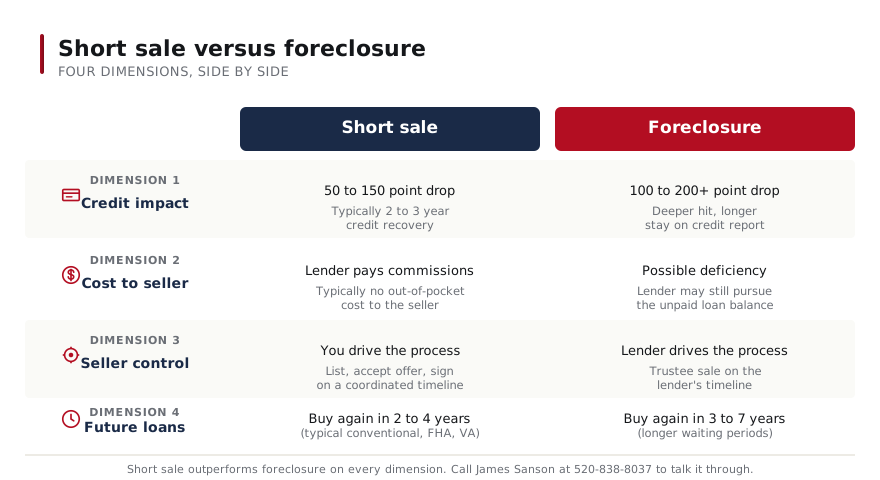
The two paths start from the same place (a mortgage you cannot afford) but go in different directions:
A short sale is the voluntary sale of your home for less than you owe on the mortgage, with your lender's permission. The lender agrees to accept the sale proceeds as satisfaction of the loan, even though they will not cover the full balance. You list the home, a buyer makes an offer, the offer is submitted to the lender for approval, and (if approved) the sale closes at the negotiated price. You walk away owing nothing on that mortgage (subject to lender terms and Arizona anti-deficiency statutes).
Foreclosure is the lender's involuntary process of taking back the home when the loan enters prolonged default. In Arizona, foreclosure is non-judicial under A.R.S. § 33-807 and § 33-808. A trustee records a Notice of Default, and then a Notice of Trustee Sale, and the home is sold at a public trustee sale (usually on the courthouse steps) to the highest bidder. The lender itself often ends up as the buyer if no third party outbids the opening credit bid. Title transfers; you no longer own the home, and the lender pursues whatever remaining remedies.
The fundamental difference: a short sale is something you do. A foreclosure is something done to you. That distinction is what drives most of the consequences that follow.
Here is the practical comparison most Maricopa homeowners want to see:
| FactorShort SaleForeclosure | ||
| Who initiates | Homeowner, with lender approval | Lender, after default |
| Credit impact | Less severe; reported as "settled for less than full balance." | More severe, reported as "foreclosure." |
| Time on credit report | Typically up to 7 years, but the score recovers faster | Typically up to 7 years; score recovery is generally slower |
| Wait to qualify for new mortgage | Generally, 2 to 4 years, depending on the loan program | Generally, 3 to 7 years, depending on the loan program |
| Control over timing | Some flexibility, you choose when to list and when to move | The lender and trustee set the schedule |
| Deficiency exposure | Often negotiated away in the approval letter; Arizona anti-deficiency may apply | Subject to Arizona statutes (A.R.S. § 33-814 and § 33-729) |
| Public record exposure | Sale recorded normally; no foreclosure docs | Notice of Default and Notice of Trustee Sale are public |
| Privacy | Looks like any other home sale to neighbors | Trustee sale notices are typically posted on the property |
| When you move out | On your timeline, before closing | Post-sale eviction if you have not left voluntarily |
| Cost to you | Typically $0 out of pocket; closing costs paid from sale proceeds with lender approval | $0 out of pocket, but credit and re-qualification costs are higher long-term |
This table summarizes the typical situation. Your specific outcome depends on your lender, your loan type, your hardship, the state of the market, and how early in the timeline you act. Each section below goes deeper.
Both short sale and foreclosure damage your credit. The damage is real and lasting. But the magnitude and recovery trajectory are different.
In a typical scenario, the missed payments leading up to either outcome cause significant initial damage to your credit score, often dropping it by 100 to 200 points. From there, the two paths diverge:
The difference matters most if you plan to buy another home, lease a car, or apply for any major credit in the next several years. For a detailed breakdown of credit consequences for both paths, see short sale credit impact.
One of the most important practical differences between the two paths is the waiting period before you can qualify for a new mortgage. The exact wait varies by loan program and your post-event credit profile:
| Loan ProgramAfter Short SaleAfter Foreclosure | ||
| Conventional (Fannie / Freddie) | 2 to 4 years, depending on circumstances | Up to 7 years standard |
| FHA | Generally 3 years, sometimes shorter with documented hardship | Generally 3 years |
| VA | Generally 2 years | Generally 2 years |
| USDA | Generally 3 years | Generally 3 years |
These guidelines change. Loan program seasoning requirements are updated periodically and vary by lender overlays. For your specific situation, speak with a licensed mortgage loan officer about current requirements. The takeaway is that, particularly under conventional loan programs, a short sale typically allows you back into the housing market faster than a completed foreclosure.
This is the difference homeowners often appreciate most after the fact. A short sale is something you participate in actively:
A foreclosure is largely something that happens to you:
If timing and dignity matter to you (most people in this situation, they do), the short sale path gives you more of both. If you are unsure where you are in the timeline, call 520-838-8037, and we can help you figure out which path is still realistically open.
The financial differences between short sale and foreclosure are nuanced and depend heavily on Arizona's specific statutes:
Deficiency in a short sale. The deficiency is the difference between what you owe and what the sale produces. In a short sale, the lender agrees to accept the sale proceeds as satisfaction of the loan. Most short sale approval letters explicitly waive the deficiency, meaning the lender will not pursue you for the unpaid balance. This is one of the most important reasons short sales work well for many homeowners. The exact terms appear in the lender's approval letter and should be reviewed carefully (ideally with an Arizona-licensed attorney) before signing.
Deficiency after foreclosure. Arizona's anti-deficiency statutes (A.R.S. § § 33-814 and 33-729) limit a lender's ability to pursue deficiency judgments after foreclosure of certain residential properties. The protections generally apply to single-family or two-family dwellings on 2.5 acres or less used as a residence. The rules have specific conditions and exceptions, including loans that were not purchase-money loans and second mortgages or HELOCs that were used for non-purchase purposes. The protections are nuanced, and whether they apply to your specific loan and property depends on facts only an Arizona-licensed attorney can evaluate.
The practical takeaway is that for many Maricopa homeowners with a primary residence purchase-money loan, both paths may result in no personal deficiency exposure. But this is not universal, and the analysis is loan-by-loan. Do not assume protection without legal review.
Both short sale and foreclosure can result in forgiven debt, which may have federal tax consequences. The IRS may treat forgiven mortgage debt as taxable income, though several exclusions may apply:
This is genuinely tax-law territory that changes frequently. Before completing either a short sale or letting a foreclosure proceed, speak with a licensed CPA or tax professional about your specific situation under current law. The advice you need is for your specific facts and the tax year you are in, not generic information.
In practice, a few specific scenarios usually point toward one path over the other:
A short sale is typically the better path when:
A short sale may not work when:
If you are not sure which option describes your situation, the next right step is to have a conversation with someone who can review your specifics. That can be a HUD-approved housing counselor at hud.gov (free, neutral), an Arizona-licensed attorney (paid, legally specific), or the James Sanson Team at 520-838-8037 (free, real-estate specific). For a deeper read on what your timeline allows, see how much time you have. If you just received foreclosure paperwork, see the Arizona Notice of Default explained.
Important.This page compares short sale and foreclosure outcomes for Maricopa homeowners in general terms. Your specific situation may have legal, tax, or financial dimensions that require professional advice. For legal questions, consult an Arizona-licensed attorney. For tax questions, consult a CPA. For free, neutral mortgage assistance counseling, contact a HUD-approved housing counselor at hud.gov. Each outcome described above is subject to lender approval, eligibility requirements, and circumstances that vary by situation. No specific result can be promised.
Most Maricopa homeowners weighing this choice find clarity after one honest conversation. Call 520-838-8037 to talk through which fits your situation, no obligation and no pressure. You can also start with your pre-foreclosure options for the broader picture, or learn how the Maricopa short sale process works if you have decided a short sale is likely the right direction. Our Maricopa short sale specialists have walked Maricopa homeowners through both paths for over two decades.
No pressure, no obligation, no charge. James will call you back personally to discuss your options. For faster help, call 520-838-8037.
Whether you're buying, selling, or just exploring, call us. No obligation.
520-838-8037James Sanson | Real Broker LLC | Licensed in Arizona
Call 520-838-8037 right now, or fill out the form and we will reach out within one business day.