

James Sanson
Lead Short Sale Negotiator
Licensed since August 2002, Maricopa focus since 2004. Handles every short sale on this site personally.
Lead Short Sale Negotiator
Licensed since August 2002, Maricopa focus since 2004. Handles every short sale on this site personally.

Buyer Specialist
7 years in Maricopa. Works with buyers writing offers on our short sale listings. Patient, thorough, answers the phone.

Bilingual Buyer Specialist
Habla espanol. 8 years experience. Works with buyers across 85138 and 85139 on our short sale listings.
Arizona foreclosure runs about 110 to 180 days from first missed payment to trustee sale. Here is the exact sequence and where you can still act.
Real Broker LLC · Licensed in Arizona
How long does an Arizona foreclosure take? Arizona is a non-judicial foreclosure state, and most Arizona foreclosures run roughly 110 to 180 days from the first missed payment to the trustee sale date. Once a Notice of Trustee Sale is recorded, Arizona law (A.R.S. § 33-807 and § 33-808) requires at least 90 days before the sale can occur. The earlier you act in this window, the more options you have. Acting after the Notice of Trustee Sale is recorded narrows those options quickly.
If you are reading this, the timeline matters to you. Maybe you missed a payment, and you are trying to figure out how long before things get serious. Maybe you already received a Notice of Default, and you are not sure whether you have weeks or months. Maybe you are looking at a Notice of Trustee Sale on your kitchen counter and wondering whether it is too late to do anything.
The honest answer is that Arizona moves faster than people expect. The total time from your first missed payment to a trustee sale is typically 110 to 180 days, depending on your lender and how quickly they act. That is shorter than judicial foreclosure states like Florida or New Jersey, where the same process can take years. Knowing where you are in the timeline matters because your pre-foreclosure options shrink as the sale date approaches.
This page walks you through how Arizona foreclosure timing actually works, what the milestones look like in real life, and what you can still do at each stage. We have walked Maricopa homeowners through this process since 2004. Call 520-838-8037 for a confidential, no-pressure conversation about where you stand.
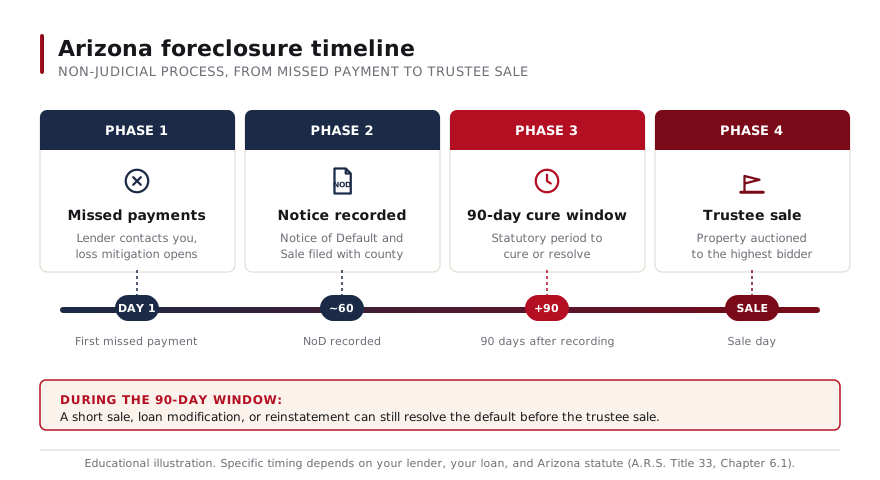
Arizona is a "non-judicial foreclosure" state. That means your lender does not have to file a lawsuit and wait for a judge to approve the foreclosure. Instead, the lender uses a process built into the deed of trust you signed when you bought your home. This process is governed by A.R.S. § 33-807 and § 33-808 and moves through the County Recorder, not the courts.
For most Maricopa homeowners in default, the practical timeline looks like this:
The exact day count varies by lender. Some servicers move quickly. Others sit on files for months before referring to the trustee. Some loan types (VA, FHA, USDA) have additional federal procedural steps that add time. The single biggest variable is your lender, not Arizona law.
The reason Arizona timelines are shorter than the national average comes down to the deed of trust structure. When you bought your home with a mortgage in Arizona, you likely signed a deed of trust rather than a true mortgage. A deed of trust includes a "power of sale" clause that gives a trustee (not your lender directly, and not a court) the authority to sell your property if you default.
This matters because:
Compared to a judicial foreclosure state, where the process can take 18 to 36 months, Arizona's 110 to 180-day timeline gives less room to maneuver. That is not a flaw. It is just how Arizona has structured its real estate law. The practical takeaway is that acting early matters more here than it would in other states.
There are four key milestones in a Maricopa pre-foreclosure timeline. Knowing which one you are at tells you what is still possible.
Your mortgage is technically in default the day after your grace period ends, which is usually 15 days after the due date. Late fees apply. Your servicer's automated systems start calling and mailing within a few days. At this stage, nothing has been recorded against your home. Your credit may have taken a small hit if the missed payment crosses a 30-day reporting boundary, but the public foreclosure clock has not started yet.
This is the window where reinstatement, payment plans, and forbearance are most accessible. If you can catch up within 30 days, the lender will not escalate further in many cases.
By the time you miss a second and third payment, the loan moves from collections to loss mitigation. A specific case manager may be assigned. The lender's tone usually changes from automated reminders to letters requesting a "loss mitigation application" or similar package.
This is when most homeowners start seriously researching options. It is also when you have the most room to negotiate. Loan modification, forbearance, short sale, and reinstatement are all still on the table. Speaking with a free HUD-approved housing counselor at this stage is often the highest-value thing you can do.
In many Arizona foreclosures, a formal Notice of Default is recorded with the Pinal County Recorder once the loan is roughly 90 to 120 days past due. Not every Arizona lender records a separate Notice of Default first. Some go straight to the Notice of Trustee Sale step. Either way, by this point, the foreclosure process is no longer just internal. It is a matter of public record. What a Notice of Default means is covered in detail on its own page.
At this stage, a short sale becomes a primary option for homeowners who cannot or do not want to keep the home. Loan modification is still possible, but harder, because the lender has now formally committed to the foreclosure track.
This is the most significant milestone. The Notice of Trustee Sale is recorded with the Pinal County Recorder, posted on the property, and mailed to the homeowner. Arizona law requires at least 90 days between the recording of this notice and the actual sale date. The sale date is named on the notice itself.
Once this notice is recorded, your timeline is fixed. Whatever options you still have must work within the 90-day window. A short sale can sometimes pause or postpone the trustee sale if a deal is in progress and the lender agrees. Loan modification becomes much harder. Reinstatement requires payment of the full arrears, late fees, attorney fees, and trustee fees in a single lump sum.
If you are at this stage, contact a HUD-approved counselor at hud.gov or a licensed Arizona attorney immediately. Do not wait.
To make this concrete, here is what a typical timeline looks like for a Maricopa homeowner whose hardship started on January 1:
| Approximate Day:What happens | |
| Day 1 | First missed payment. A grace period of about 15 days begins. |
| Day 16 | Late fees applied. Automated calls begin. |
| Day 31 | The second missed payment may be reported to the credit bureaus. Mailed letters intensify. |
| Day 60 | Third missed payment. The loss mitigation department is typically engaged. |
| Day 90 to 120 | The lender refers the loan to a trustee. Notice of Default may be recorded with Pinal County. |
| Day 120 to 150 | Notice of Trustee Sale recorded and mailed. Sale date set 90+ days out. |
| Day 210 to 240 | A trustee sale occurs unless reinstatement, a short sale, or another resolution intervenes. |
These are illustrative averages, not guarantees. Your specific timeline depends on your lender, your loan type, and any federal protections that may apply. Active duty service members, for example, have additional protections under the Servicemembers Civil Relief Act that may extend the timeline.
Several things can extend an Arizona foreclosure timeline beyond the typical 180 days:
None of these is a reason to relax. There are reasons to use the extra time strategically. Each one comes with conditions, and most require action on your part to trigger.
Some factors compress the timeline and reduce your options faster than the average:
If any of these apply to you, the practical effect is that your 180-day window may actually be closer to 110 or 120 days. Act sooner, not later. If you are uncertain how aggressive your lender or HOA may be, call 520-838-8037, and we can talk through what you are seeing.
What you can still do depends entirely on where you are in the timeline. Here is the honest version, stage by stage:
This is the most flexible window. Reinstatement, repayment plans, forbearance, loan modification, short sale, and deed in lieu are all on the table. Speaking with your servicer's loss mitigation department and a HUD-approved counselor at this stage frequently produces the best outcomes. If you are weighing options between keeping the home and selling it, deciding between loan modification and short sale is a useful next step.
Most options are still available, but loan modification becomes harder. Short sale is increasingly the most realistic path for homeowners who cannot keep their homes. Reinstatement is still possible if you can pay the past-due amount plus any late fees.
The 90-day clock is running. A short sale can sometimes pause or postpone the sale, but only if the lender agrees and a deal is far enough along. Reinstatement requires the full past-due amount plus all fees in a lump sum. Loan modification is rare at this stage. Bankruptcy filing triggers an automatic stay, but it is a serious legal step. Comparing short sale and foreclosure outcomes at this stage is critical. If you have a scheduled sale date in hand, call 520-838-8037 today, and we will walk you through what is still possible.
Once the sale has occurred, your ownership of the home has transferred to the buyer (often the lender itself if no third party bids higher). Arizona generally does not allow a post-sale redemption period for residential property under power-of-sale foreclosure. At that point, the foreclosure is complete, and your remaining concerns are credit impact, deficiency exposure (often limited under Arizona anti-deficiency statutes A.R.S. § 33-814 for residential property), and possible tax consequences on any forgiven debt.
Important.This page describes typical Arizona foreclosure timelines for educational purposes. Your specific situation may differ depending on your lender, loan type, and circumstances. For legal advice about your specific situation, consult an Arizona-licensed attorney. For free, neutral mortgage assistance counseling, contactHUD-approved housing counselors in Arizona.
The earlier in the timeline you start exploring options, the more paths remain open. If you are uncertain where you stand or what your next move should be, call us at 520-838-8037 for a confidential conversation. We will tell you honestly whether a short sale fits your situation, whether you would be better served by a loan modification, or whether you should speak with an attorney first.
You can also see the pre-foreclosure resource page for a broader overview, or learn how a short sale affects your credit if that is the question most on your mind. If you have decided a short sale is likely the right path, the next step is how the short sale process works from listing through closing. Talking with our Maricopa short sale specialists costs you nothing and creates no obligation.
No pressure, no obligation, no charge. James will call you back personally to discuss your options. For faster help, call 520-838-8037.
Whether you're buying, selling, or just exploring, call us. No obligation.
520-838-8037James Sanson | Real Broker LLC | Licensed in Arizona
Call 520-838-8037 right now, or fill out the form and we will reach out within one business day.