

1,000+ Closings 267 Five-Star Reviews FastExpert 2026 Top Agent
James Sanson, REALTOR

James Sanson

Lead Short Sale Negotiator

Licensed since August 2002, Maricopa focus since 2004. Handles every short sale on this site personally.

David Hoos, REALTOR

David Hoos

Buyer Specialist

7 years in Maricopa. Works with buyers writing offers on our short sale listings. Patient, thorough, answers the phone.

David Ruiz, REALTOR

David Ruiz

Bilingual Buyer Specialist

Habla espanol. 8 years experience. Works with buyers across 85138 and 85139 on our short sale listings.

When to Call a HUD-Approved Housing Counselor in Arizona (Before You List)

Free, unbiased counseling from federally certified counselors. What they can do that a Realtor cannot, and when you should call one first.

Real Broker LLC · Licensed in Arizona

By James Sanson, REALTOR. Licensed Arizona REALTOR since August 2002. Maricopa specialist since 2004. 1,000+ closings. Seethe team's short sale credentials.
Published May 16, 2026 · Updated May 16, 2026
Quick answer

A HUD-approved housing counselor is a free, neutral, federally funded resource that helps homeowners in financial difficulty understand their options. The counselors are paid by federal grant funds, not by selling you anything, so they have no incentive to push you toward a particular outcome. In Arizona, you can find one through the HUD directory at hud.gov or by calling the HUD helpline at 1-800-569-4287. For most Maricopa homeowners facing foreclosure, a HUD counselor is the right first call. Once you have done that, if a short sale appears to be the right path, you can call 520-838-8037.

Every other page on this site mentions HUD-approved housing counselors. We point people to them constantly, and there is a specific reason for that. A HUD counselor is the closest thing to neutral, qualified, and free advice in the mortgage-distress space. For Maricopa homeowners trying to figure out what to do about a mortgage they cannot afford, calling one is usually the most useful single action they can take.

This page explains what a HUD-approved housing counselor is, what to expect from the conversation, how to find one who serves Arizona, and why we recommend you talk to one before deciding what to do about your situation, including whether to call us. Genuine. The James Sanson Team handles short sales when they are the right answer. If a HUD counselor reviews your situation and determines that a different path is a better fit, that is the path you should take, and we will refer you to it.
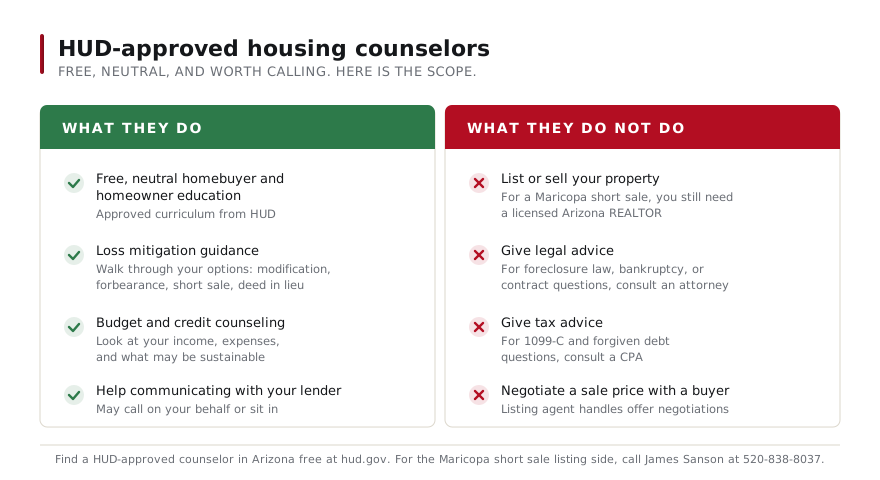
Two column reference showing what HUD approved housing counselors do (free education, loss mitigation guidance, budget counseling, lender communication help) and what they do not do (list and sell property, legal advice, tax advice, negotiate sale prices)
What HUD-approved housing counselors do, and what they do not do.

What a HUD-approved housing counselor is

A HUD-approved housing counselor is a trained professional who works for a nonprofit agency certified by the U.S. Department of Housing and Urban Development to provide housing counseling. The certification is meaningful. To become a HUD-approved counselor, an individual must complete training, pass a HUD certification exam, and work for a HUD-approved agency.

The agencies that employ HUD counselors are nonprofits, often community development organizations, credit-counseling organizations, or faith-based service organizations. They typically receive funding through federal grants administered by HUD, sometimes supplemented by state grants or private donations. The counseling itself is provided to homeowners at no charge.

Several different types of housing counseling are offered through HUD-approved agencies, but the most relevant to homeowners in your situation are foreclosure prevention counseling and mortgage delinquency counseling. These specific services focus on helping you understand your options, work with your lender, and decide what to do.

Why it is free (and what that means)

The counseling is free to the homeowner because the federal government, through HUD, funds the counseling agencies to provide these services. The grant money flows from HUD to approved agencies, which then deliver counseling at no cost to consumers. This funding model is intentional and matters for understanding the value of the service.

Because the counselor is not paid by you or by any lender, real estate agent, or other service provider tied to a particular outcome, the counselor has no commercial incentive to recommend one path over another. This is in stark contrast to nearly every other professional who might advise you in this situation. Real estate agents (including us) earn money only when a property is sold. Loan modification negotiation companies earn money only when they bill for services. Bankruptcy attorneys earn money only when they file bankruptcy cases. A HUD counselor, paid by federal grant funds regardless of which option you choose, can recommend the option that genuinely fits your situation.

This is not to suggest the other professionals are dishonest. Most are not. But the structural incentives are real. The HUD counselor's role exists specifically because federal policy recognizes that homeowners in financial distress benefit from advice not tied to a particular sales outcome.

What HUD counselors actually do

The work of a HUD-approved counselor is concrete and practical. In a typical foreclosure-prevention counseling engagement, a counselor will:

  1. Review your loan documents. The original deed of trust, mortgage note, and any modifications or correspondence from the lender. This often surfaces details the homeowner did not realize were there.
  2. Review your full financial picture. Income, expenses, other debts, assets. This is broader than what a real estate agent or even a mortgage loss mitigation department typically reviews.
  3. Explain the options realistically available to you. Reinstatement, repayment plan, forbearance, loan modification, short sale, deed in lieu, bankruptcy, or doing nothing. Each option is discussed in the context of your specific situation.
  4. Help you build a loss mitigation application. If you decide to pursue loan modification, forbearance, or repayment, the counselor can help you assemble the documentation package your lender will need.
  5. Communicate with your lender on your behalf if you authorize it. Many counselors will speak directly with your servicer's loss mitigation department to advocate for the option that fits your situation.
  6. Refer you to other professionals when needed. Legal aid for foreclosure defense, bankruptcy attorneys for insolvency questions, CPAs for tax questions, and real estate agents experienced in short sales when that path fits.

What HUD counselors typically do not do: provide legal representation in court, file documents for bankruptcy, sell your home, or guarantee any specific outcome with your lender. For those services, they refer you to the appropriate professional.

When to call a HUD counselor

The honest answer is: as early as possible. The most common regret we hear from Maricopa homeowners is that they waited too long. Specific moments when calling a HUD counselor are particularly useful:

  1. The first missed mortgage payment. Before you have fallen so far behind that options narrow.
  2. When you receive a hardship-related letter from your lender. Loss mitigation outreach, payment plan offers, or default warnings.
  3. After receiving a Notice of Default. If you got the document and are not sure what to do next, see if you got a Notice of Default for context, then call a counselor.
  4. Before signing anything offered by a "foreclosure rescue" company. Scam patterns specifically target homeowners who have just received foreclosure paperwork. A HUD counselor can review any offer before you commit.
  5. When you are weighing options. Before deciding between loan modification, short sale, deed in lieu, or letting foreclosure proceed.
  6. When something feels off. If your lender or a third party is pressuring you toward a particular outcome and you are not sure if it is right, a HUD counselor can give you a second opinion at no cost.

The closer you get to a scheduled trustee sale, the less time the counselor has to help. The earlier you call, the more options remain available. If you have a sale date scheduled, call today. If you are weeks behind on payments and worried about what comes next, call this week.

What to bring to the call or meeting

To get the most out of the conversation, gather the following before the call:

  1. Your most recent mortgage statement. Showing the current balance, past-due amount, and contact information for your servicer.
  2. Any recent correspondence from your lender. Default notices, loss mitigation letters, payment plan offers, or any other written communication.
  3. Any Notice of Default or Notice of Trustee Sale, if you have received one.
  4. Your most recent pay stubs. Two or three months for each working adult in the household.
  5. Recent bank statements. Two to three months for each account.
  6. Recent tax returns. Last one or two years.
  7. A list of monthly expenses. Mortgage, utilities, insurance, food, transportation, and other debts. Even rough numbers help.
  8. A short written summary of what changed. What caused the hardship, and when did it start? Job loss, medical issue, divorce, business decline, death in the family. This serves as the basis for a hardship letter if one is needed.

You do not need all of this to make the initial call. Counselors typically work with whatever information you have available and help you assemble what is missing. Do not delay the call just because you do not have all the documents. Call, and start from where you are.

What to expect from the conversation

The first conversation with a HUD counselor is typically 45 minutes to an hour, sometimes longer if there is a lot to review. It may happen by phone, video, or in person. Many Arizona counseling agencies now do most of their work by phone.

You can expect the counselor to:

  1. Ask detailed questions about your income, expenses, and the cause of your hardship
  2. Ask for permission to discuss your situation with your lender (you sign a form authorizing this)
  3. Walk you through the realistic options for your specific situation
  4. Give you a written action plan or follow-up summary
  5. Schedule one or more follow-up conversations as your situation progresses

You should not expect the counselor to:

  1. Tell you what to do without first understanding your full situation
  2. Pressure you toward any particular outcome
  3. Charge a fee at any point
  4. Make decisions for yourself (the choice of which path to pursue is yours)
  5. Provide legal representation or specific tax advice (these are referred out)

If a counselor or anyone claiming to be a counselor asks you for money, pressures you toward a particular outcome, or asks you to sign over the deed to your property, that is a strong signal that something is wrong. Legitimate HUD-approved housing counselors do not do these things.

How to find a counselor serving Arizona

There are several ways to find a HUD-approved housing counselor for your situation:

  1. HUD's online directory. The official search tool at HUD-approved housing counselors lets you search by state, ZIP code, and service type. Filter for "Mortgage Delinquency and Default Resolution" or similar foreclosure-related services.
  2. HUD helpline. Call 1-800-569-4287 to speak with HUD staff who can direct you to a counselor serving your area.
  3. Consumer Financial Protection Bureau. The CFPB maintains a referral tool at consumerfinance.gov that also draws from HUD's approved list.
  4. Arizona Department of Housing. The state agency maintains contacts with HUD-approved agencies serving Arizona homeowners.

Many counselors who serve Arizona homeowners are based in Phoenix, Tucson, or other Arizona cities, but you do not have to choose a counselor in your immediate area. Many do their work by phone and serve homeowners across the state. Many also have Spanish-speaking counselors available. If you need a counselor who speaks a specific language, ask when you call the helpline or check the directory filter.

What happens after you talk to a counselor

The conversation with the counselor is a starting point, not a finish line. Depending on what you discuss, the next steps usually include one or more of the following:

  1. Submit a loss mitigation application to your lender. If a loan modification, repayment plan, or forbearance fits your situation. The counselor often helps with this directly.
  2. Listing the home for a short sale. If selling is the right answer, the counselor refers you to a real estate agent experienced in short sales. This is where the James Sanson Team comes in for Maricopa homeowners. Call 520-838-8037 once you have decided this is the path.
  3. Consulting an attorney. If foreclosure defense, bankruptcy, or complex legal questions come up, the counselor refers you to legal aid (for income-qualifying homeowners) or a private Arizona attorney.
  4. Consulting a CPA. If there are significant tax implications from forgiven debt or other elements of the resolution. See the credit impact of a short sale for related considerations.
  5. Following up with the counselor. Many counseling engagements involve multiple conversations as the situation evolves. Stay engaged.

The counselor's role does not end after the first call. If you authorize them to communicate with your lender, they may follow up over the course of weeks or months as your loss mitigation application is processed.

Why we recommend this first

This page exists because we believe homeowners in mortgage distress are best served by receiving neutral advice before they make decisions that affect their credit, finances, and housing for years to come. A real estate agent (us included) is not the right first call for every homeowner who is behind on a mortgage. For some, loan modification or forbearance is the better path. For some, bankruptcy is the right answer. For some, the issue is broader than just the mortgage, and a full financial review with a counselor surfaces options the homeowner did not know existed.

We regularly refer Maricopa homeowners to HUD counselors. We do it because the homeowner is better served by understanding all their options, and we are better served by working with homeowners for whom a short sale is genuinely the right answer. If you call us and a short sale is not the right path for your situation, we will let you know. The HUD counselor can help you arrive at that conclusion with a full picture, not just the short-sale-shaped picture we would naturally see.

Important.This page describes HUD-approved housing counseling services for Maricopa homeowners in general terms. The counseling itself is provided by independent nonprofit agencies, not by The James Sanson Team. The James Sanson Team is not a HUD-approved housing counselor and does not provide housing counseling services. We provide real estate brokerage services for short sales when that path is appropriate for a homeowner's situation. For legal advice, consult an Arizona-licensed attorney. For tax advice, consult a CPA. For free, neutral mortgage assistance counseling, contact a HUD-approved housing counselor at hud.gov.

If, after speaking with a HUD-approved counselor, you decide that a short sale is the right path for your situation, call 520-838-8037 to discuss the details. For a broader context, return to the pre-foreclosure resource page. If you are still deciding among paths, compare loan modification vs short sale, or read about the Arizona foreclosure timeline to understand how much time you have. If you are leaning toward a short sale, the next step is to learn how a short sale works. Our Maricopa short sale team has guided Maricopa homeowners through this exact decision since 2004.

Tell us about your situation

No pressure, no obligation, no charge. James will call you back personally to discuss your options. For faster help, call 520-838-8037.

Before you submit

You may stop doing business with us at any time. You may accept or reject the offer of mortgage assistance we obtain from your lender. If you reject the offer, you do not have to pay us. If you accept the offer, you will pay us based on the agreed listing terms.

The James Sanson Team is not associated with the government, and our service is not approved by the government or your lender.

Even if you accept this offer and use our service, your lender may not agree to change your loan.

James Sanson | Real Broker LLC | Licensed in Arizona

Conversations are confidential and carry no obligation. Not legal, tax, or financial advice. For impartial mortgage assistance counseling, contact a HUD-approved housing counselor at hud.gov.

Licensed since August 2002 Maricopa focus since 2004 Short sale experience since 2008 FastExpert 2026 Top Agent

Frequently asked questions

Is HUD-approved housing counseling really free?
Yes, completely free to the homeowner. The counseling agencies are paid through federal grants administered by HUD, sometimes supplemented by state grants or private donations. You should never be asked to pay for HUD-approved housing counseling services. If anyone claiming to be a HUD counselor asks for money, that is a sign that something is wrong, and you should verify the agency's HUD approval through the official HUD directory before proceeding.
How is a HUD counselor different from a loan modification company?
The main differences are who pays them and whether they can charge you. HUD-approved counselors are paid by federal grant funds and provide services at no cost. Loan modification companies (sometimes called "foreclosure rescue" or "loss mitigation" companies) are private businesses that charge fees and, under the federal MARS Rule, are generally prohibited from charging upfront fees for mortgage assistance or relief services. HUD counselors are nonprofit and federally certified; loan modification companies are private commercial enterprises with widely varying quality and legitimacy.
Will calling a HUD counselor affect my credit?
No. The counseling itself does not appear on your credit report and does not affect your credit score. There is no credit inquiry, no account opened, and no public record generated as a result of the counseling engagement. Your conversations with the counselor are confidential.
Can a HUD counselor stop my foreclosure?
A HUD counselor alone does not have the authority to stop a scheduled foreclosure. What they can do is help you build a strong loss mitigation application, communicate with your lender on your behalf, identify options you may not have known about, and connect you with legal resources if foreclosure defense is appropriate. Whether the foreclosure can be paused or stopped depends on the specific options available to you. The counselor's value is in helping you understand and pursue those options, not in providing direct legal action.
What if I cannot find a HUD counselor in Maricopa?
Most HUD-approved counselors who serve Arizona homeowners work by phone and can serve clients across the state, regardless of their physical location. Maricopa homeowners are typically well served by counselors based in Phoenix, Tucson, or Casa Grande. Use the HUD directory at hud.gov to find agencies serving Pinal County, then call to set up an appointment.
What if the HUD counselor recommends something other than a short sale?
Then that is probably the better path for your situation, and you should pursue it. We regularly refer Maricopa homeowners to HUD counselors, precisely because they can review the full picture without commercial bias. If a loan modification, forbearance, repayment plan, or other option fits your situation better than a short sale, that is the right answer. We are happy to be a resource if a short sale later proves to be the right path, but the goal is the right outcome for you, not a transaction for us.
Is there a HUD counselor that specifically helps with VA or FHA loans?
Most HUD-approved counselors are trained to work with all loan types, including VA, FHA, USDA, and conventional. Some counselors or agencies may have particular expertise with specific loan types. When you call, ask whether the counselor has experience with your loan type. The HUD directory and helpline can also direct you to a counselor with a relevant background if your loan has specific federal program features.

Talk to a Maricopa specialist today

Whether you're buying, selling, or just exploring, call us. No obligation.

520-838-8037

James Sanson | Real Broker LLC | Licensed in Arizona

Talk to a Maricopa short sale specialist

Call 520-838-8037 right now, or fill out the form and we will reach out within one business day.

Before you submit

You may stop doing business with us at any time. You may accept or reject the offer of mortgage assistance we obtain from your lender. If you reject the offer, you do not have to pay us. If you accept the offer, you will pay us based on the agreed listing terms.

The James Sanson Team is not associated with the government, and our service is not approved by the government or your lender.

Even if you accept this offer and use our service, your lender may not agree to change your loan.

James Sanson | Real Broker LLC | Licensed in Arizona

Conversations are confidential and carry no obligation. Not legal, tax, or financial advice. For impartial mortgage assistance counseling, contact a HUD-approved housing counselor at hud.gov.