

James Sanson
Lead Short Sale Negotiator
Licensed since August 2002, Maricopa focus since 2004. Handles every short sale on this site personally.
Lead Short Sale Negotiator
Licensed since August 2002, Maricopa focus since 2004. Handles every short sale on this site personally.

Buyer Specialist
7 years in Maricopa. Works with buyers writing offers on our short sale listings. Patient, thorough, answers the phone.

Bilingual Buyer Specialist
Habla espanol. 8 years experience. Works with buyers across 85138 and 85139 on our short sale listings.
How the two paths differ in credit impact, deficiency liability, and timeline, with a frank look at when each one makes sense.
Real Broker LLC · Licensed in Arizona
A short sale occurs when the mortgage is sold by selling the home for less than you owe. A deed in lieu of foreclosure exits the mortgage by transferring the deed directly to the lender. Most lenders prefer a short sale first because they recover more value. Most homeowners benefit more from a short sale because credit recovery is faster. A deed in lieu makes sense in specific cases (no buyer despite genuine listing effort, no junior liens, lender willing). Talk to a free HUD-approved housing counselor at hud.gov before deciding. Call 520-838-8037 if a short sale may be a good fit for your situation.
If you have decided that keeping your Maricopa home is not realistic, the next question is how to exit. The two voluntary paths (where you participate in the outcome rather than waiting for foreclosure to do it for you) are short sale and deed in lieu of foreclosure. Both end with you no longer owning the home and the mortgage being satisfied. The differences lie in how each works mechanically, who must agree, what appears on your credit report, and the timing each requires.
This page walks through both honestly. The James Sanson Team handles short sales directly and has done so for Maricopa homeowners since 2004. We do not handle deed-in-lieu negotiations as a primary service, but we have seen many situations where one path or the other made more sense. Before deciding, the right first call is usually to a free HUD-approved housing counselor at hud.gov, who can review both options with you neutrally.
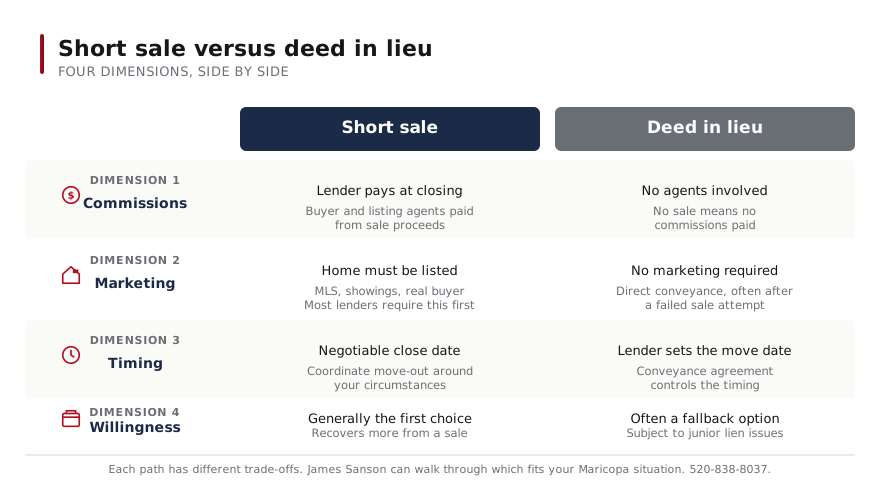
A short sale is the sale of your home for less than you owe on the mortgage, with your lender's permission. You list the home, a buyer makes an offer, the lender approves the price (which will not cover the full loan balance), and the sale closes. You walk away with the mortgage satisfied, subject to lender terms in the approval letter and Arizona anti-deficiency statutes. There is a buyer involved. A real estate agent typically handles the listing and lender negotiation.
A deed in lieu of foreclosure is a voluntary transfer of the property's deed directly to the lender in exchange for the lender releasing the borrower from the mortgage debt. There is no sale to a third-party buyer. You sign the deed over, the lender takes the property, and the mortgage is considered satisfied (subject to whatever terms the lender agrees to in writing). The lender now owns the home and will eventually sell it, but that is no longer your concern.
The fundamental distinction is whether a third-party buyer is involved. A short sale produces a sale to a new owner. A deed in lieu transfers the home directly to the lender.
| FactorShort SaleDeed in Lieu | ||
| Outcome | Home sold to a buyer; mortgage satisfied | Deed transferred to lender; mortgage satisfied |
| Third-party buyer | Yes, needed for the transaction | No, the lender takes the property |
| Marketing time | Required; listing typically 30 to 90 days | Not required, though some lenders require a prior short-sale attempt |
| Total timeline | 90 to 180 days from listing to closing | 60 to 120 days from application to deed transfer |
| Credit impact | Reported as "settled for less than full balance." | Reported as "deed in lieu" or similar; treated similarly to short sale by most scoring models |
| Wait for new mortgage | Generally, 2 to 4 years, depending on the loan program | Generally, 4 to 7 years, depending on the loan program; commonly longer than the short sale wait |
| Junior liens | Can often be negotiated; second mortgages and HELOCs are commonly settled | Major obstacle: junior liens generally must be removed or extinguished first |
| Deficiency | Typically waived in the approval letter; AZ anti-deficiency may also apply | Should be addressed in a written agreement; do not assume waiver |
| Cash for keys/relocation assistance | Sometimes available from the lender at closing | Sometimes negotiated as part of the deal |
| Who runs the process | Real estate agent + lender loss mitigation | Homeowner + lender loss mitigation, sometimes with an attorney |
This is often a surprise to homeowners: most lenders, given the choice, would rather see you attempt a short sale than accept a deed in lieu. The reason is straightforward. A short sale produces a sale to a buyer who pays close to market value. The lender recovers more money than they typically would by taking the property back, holding it, and later selling it themselves.
From the lender's perspective:
For this reason, many lenders require borrowers to attempt a short sale first before considering a deed in lieu. Some explicitly state this in their loss mitigation policy. If you approach your servicer asking only about deed in lieu without having attempted a sale, you may be told to list the property first.
Deed in lieu is the right path in specific circumstances. The clearest cases:
If most of these apply, a deed in lieu may be your best option. If even one major condition is missing (especially junior liens or lender unwillingness), the path will likely not be available, and a short sale or another option becomes the realistic alternative.
This is the single biggest obstacle to deed-in-lieu transactions and is worth understanding clearly. When you sign over the deed to your senior lender, the senior lender takes title to the property. But the deed transfer does not automatically extinguish other liens against the property. A second mortgage, HELOC, judgment lien, mechanics lien, or HOA arrears lien remains attached to the property after the deed transfer.
The senior lender ending up with a property that still has junior liens is not ideal. They want a clear title. So either:
This is one of the practical reasons short sales work, whereas deeds in lieu do not. In a short sale, the proceeds from the buyer can be used to negotiate partial payments to junior lienholders in exchange for lien releases, and the senior lender can structure approval contingent on those releases. There is money in the deal to allocate. In a deed in lieu, there is no buyer's money in the deal, so junior liens become a hard obstacle. If you have any junior liens on the property, talk to a HUD-approved housing counselor or an Arizona attorney about whether a deed in lieu is realistically available to you. Call 520-838-8037 if you want to explore whether a short sale could resolve the situation instead.
For the deeper walkthrough, see the short sale process explained.
The total timeline typically runs 60 to 120 days, though title issues or junior lien complications can extend it significantly.
Both short sale and deed in lieu damage your credit, though typically less severely than a completed foreclosure. The credit scoring models generally treat the two similarly, though the specific reporting differs. The missed payments leading up to either outcome cause the bulk of the initial damage. The credit entry typically stays on your report for up to 7 years from the original delinquency. For a more detailed look at how a short sale affects your credit, see below.
One practical difference: the waiting period before requalifying for a new mortgage is often longer after a deed in lieu than after a short sale, particularly under conventional loan programs. If returning to homeownership matters to you in the next few years, this is worth weighing.
For short sales, the lender's approval letter typically includes language waiving the deficiency. Arizona anti-deficiency statutes (A.R.S. § 33-814 and § 33-729) may also apply to certain residential properties, providing additional protection independent of the lender's agreement.
For deed in lieu, deficiency treatment is typically negotiated in the deed in lieu agreement and should be explicitly addressed in writing before you sign anything. Do not assume the lender's acceptance of the deed releases you from deficiency liability unless the written agreement says so. Have any deed-in-lieu agreement reviewed by an Arizona-licensed attorney before signing.
Both paths can result in forgiven mortgage debt, which the IRS may treat as taxable income. The Mortgage Forgiveness Debt Relief Act and the insolvency exclusion may apply in your situation, but federal tax law in this area changes frequently. Speak with a licensed CPA before completing either path about how the tax treatment will work for your specific facts under current law.
Most Maricopa homeowners weighing these two options find clarity by working through the following honest questions:
If your situation points toward a short sale, call 520-838-8037 to talk through specifics. If deed in lieu looks like a better fit (or if you are unsure), start with a HUD-approved housing counselor or an Arizona-licensed attorney.
Important.This page compares short sale and deed in lieu in general terms for Maricopa homeowners. Your specific situation may have legal, tax, or financial dimensions that require professional advice. For legal questions about deed-in-lieu agreements, deficiency treatment, or title issues, consult an Arizona-licensed attorney. For free, neutral mortgage assistance counseling, contact a HUD-approved housing counselor at hud.gov. Each outcome described above is subject to lender approval, eligibility requirements, and circumstances that vary by situation. No specific result can be promised.
If you have already received foreclosure paperwork and are weighing exit options, also read what the Notice of Default means in Arizona after receiving that document. To compare both of these against the foreclosure path itself, see how short sale and foreclosure differ. For the broader context, return to your pre-foreclosure resource page. Our Maricopa short sale team has walked Maricopa homeowners through exit decisions like this since 2004. Call 520-838-8037 for a confidential conversation.
No pressure, no obligation, no charge. James will call you back personally to discuss your options. For faster help, call 520-838-8037.
Whether you're buying, selling, or just exploring, call us. No obligation.
520-838-8037James Sanson | Real Broker LLC | Licensed in Arizona
Call 520-838-8037 right now, or fill out the form and we will reach out within one business day.