

1,000+ Closings 267 Five-Star Reviews FastExpert 2026 Top Agent
James Sanson, REALTOR

James Sanson

Lead Short Sale Negotiator

Licensed since August 2002, Maricopa focus since 2004. Handles every short sale on this site personally.

David Hoos, REALTOR

David Hoos

Buyer Specialist

7 years in Maricopa. Works with buyers writing offers on our short sale listings. Patient, thorough, answers the phone.

David Ruiz, REALTOR

David Ruiz

Bilingual Buyer Specialist

Habla espanol. 8 years experience. Works with buyers across 85138 and 85139 on our short sale listings.

Cannot Afford Your Maricopa Mortgage Anymore? Here Are Your Real Choices

The honest list of options when payments are no longer sustainable, including the ones a Realtor will not earn anything on.

Real Broker LLC · Licensed in Arizona

By James Sanson, REALTOR. Licensed Arizona REALTOR since August 2002. Maricopa specialist since 2004. 1,000+ closings. Seethe team's short sale credentials.
Published May 16, 2026 · Updated May 16, 2026
Quick answer

If you cannot afford your Maricopa mortgage payments, the most important thing to know is that you have options, but those options shrink as you fall further behind. The right first steps are: contact your servicer's loss mitigation department, talk to a free HUD-approved housing counselor at hud.gov, and get an honest read on your situation before making any major decisions. Depending on your circumstances, paths forward include loan modification, forbearance, short sale, or, in some cases, reinstatement. Call 520-838-8037 to think through whether selling fits your situation, but call a HUD counselor first if you have not.

If you are reading this, the math has stopped working. Maybe income dropped. Maybe expenses jumped. Maybe both. Whatever the cause, you are looking at a monthly mortgage payment that no longer fits your needs, and you need to figure out what to do about it. The first thing worth knowing is that you are not alone, and the situation you are in has well-established paths forward. The second thing worth knowing is that these paths get narrower the longer you wait.

This page is built for the moment you are in right now. Whether you are current but worried, one payment behind, several months behind, or already holding a Notice of Default, the right next steps differ. We have walked Maricopa homeowners through this since 2004. Call 520-838-8037 if you want to talk through your specific situation, or speak with a HUD-approved housing counselor for free guidance at hud.gov.
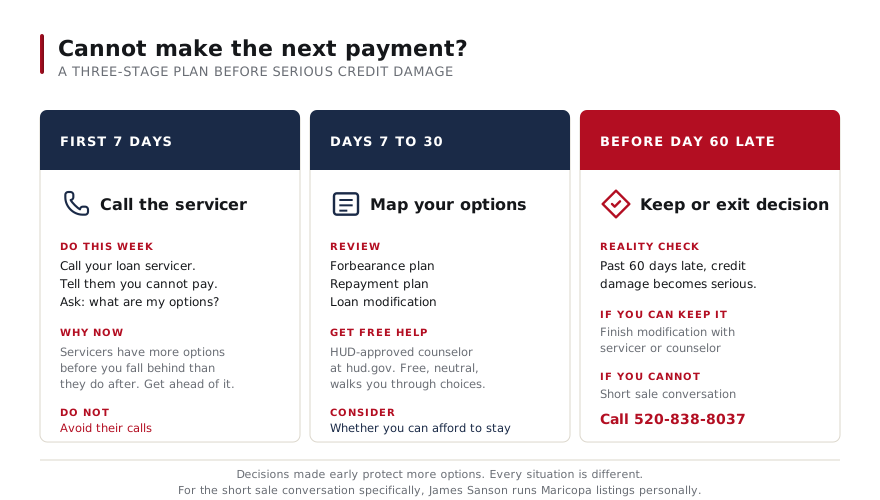
Three stage action plan for Maricopa homeowners who cannot afford their next mortgage payment: first 7 days call the servicer, days 7 to 30 map your options, before day 60 late make the keep or exit decision
A staged plan to take action before serious credit damage occurs.

First: figure out where you are

The options available to you depend heavily on where you are in the timeline. Pre-foreclosure in Arizona moves through predictable stages, and what works at one stage may no longer be possible at the next. Identify which describes you right now:

  1. Current but worried. You are still making payments, but anticipate trouble soon. Income reduction, large upcoming expense, or recent life change that you can see ahead of you.
  2. One or two payments behind. Late fees are applying, automated calls are starting, but no formal foreclosure activity yet.
  3. Three or more payments behind. The loss mitigation department is engaging, formal letters are arriving, and foreclosure track preparation is likely underway.
  4. Notice of Default received. Formal recorded document at the Pinal County Recorder. The foreclosure track has officially begun.
  5. Notice of Trustee Sale received. The most urgent stage. A specific sale date is set, and Arizona law requires at least 90 days between recording and sale. You are inside that window.

The earlier you are on this list, the more options remain. The closer to a scheduled trustee sale, the more your choices narrow. Move on to what you can do this week.

If you can act before missing a payment

This is the most valuable position for two reasons. First, all options are still available to you: loan modification, forbearance, refinancing (if you qualify), a repayment plan, or a proactive sale. Second, you have not yet damaged your credit with missed payments, so a clean exit (like selling normally or refinancing) remains realistic.

Specific actions to take while still current:

  1. Contact your servicer's loss mitigation department before missing a payment. Many servicers have programs for borrowers experiencing anticipated hardship, including pre-default forbearance or modification options that are not available once you have fallen behind.
  2. Document your situation in writing. A hardship letter explaining what changed (job loss, medical, expense increase, anticipated income reduction) and what you are asking for.
  3. Run honest numbers on what you can pay. Build a realistic monthly budget that shows what mortgage payment fits your actual income and obligations. This becomes the basis of any negotiation.
  4. Consider whether selling proactively is a better answer than fighting to stay. If the home is unaffordable long-term, a planned sale on your timeline often produces better outcomes than a forced sale or short sale later.

If you are not sure whether to stay or leave, this is exactly the conversation a HUD counselor is set up to help with. Their review is free, confidential, and not tied to any particular outcome.

If you have missed one or two payments

You have moved into the early-default zone, but the situation is still highly recoverable. Most loss mitigation programs are most accessible at this stage. Late fees have been applied; the missed payment may appear on your credit report (depending on whether it crossed the 30-day reporting threshold), and your servicer is actively reaching out.

Priority actions:

  1. Respond to your servicer. Do not ignore calls or letters. Even if you do not have a plan yet, picking up the phone and explaining the situation buys credibility and time.
  2. Request a loss mitigation application. Ask your servicer directly for their hardship application. This is the formal document that opens the door to modifications, forbearance, repayment plans, or short-sale consideration.
  3. Talk to a HUD counselor this week. The counselor can help you complete the application, communicate with the servicer, and figure out which option realistically fits.
  4. Stop the bleeding on other accounts. If you are missing other payments (credit cards, auto loans) in addition to the mortgage, the compounding credit damage worsens. Prioritize what you can pay.

At this stage, you generally still have access to all major options. Time is the variable. Each additional missed payment makes the path forward harder.

If you are 90+ days behind

After three or more missed payments, your loan has moved from collections to active loss mitigation. The lender's tone usually shifts from automated reminders to formal letters. A foreclosure referral to a trustee may be imminent if one has not already occurred. Your credit has taken substantial damage from the cumulative missed payments.

What is realistically available now:

  1. Loan modification is still possible, but harder. Lenders evaluate whether you have the income to support modified payments going forward.
  2. Short sale becomes a more prominent option, particularly if the home is underwater. The hardship is well-documented at this stage. For the full process, see how a short sale works (cross-silo reference).
  3. Forbearance may still be available for temporary hardships, but the lender typically wants to see a clear path back to affordability.
  4. Reinstatement (paying past-due in full plus fees) remains technically available, but requires lump-sum cash that most homeowners in this position do not have.
  5. Deed in lieu may be discussed, but lenders typically prefer a short sale first.

Do not delay further at this stage. Call a HUD counselor today (not next week). If you have decided that selling is realistic, see what to do with no equity for the deeper option set, or call 520-838-8037.

If you have received a Notice of Default

The formal foreclosure clock has started. The Notice of Default has been recorded with the Pinal County Recorder. The trustee may proceed to record a Notice of Trustee Sale within the next 30 to 60 days, thereby setting a specific sale date.

This is no longer a "consider your options" stage. It is a "decide and act this week" stage. Your remaining time before the sale date is potentially measured in weeks. For what the Notice of Default specifically means and the timeline it triggers, see Silo 2's foreclosure-specific content for the full walkthrough. For a broader context on what comes next, see your pre-foreclosure options.

Critical actions:

  1. Contact a HUD-approved housing counselor today
  2. If you have not engaged your servicer's loss mitigation department, do so this week
  3. Consider consulting an Arizona-licensed attorney about foreclosure defense or workout negotiation
  4. If a short sale is realistically on the table, list the home this week, not next month

Call 520-838-8037 if you have a Notice of Default in hand and want to talk through whether a short sale fits your situation. We will be honest about whether your timeline allows it and refer you elsewhere if a different path makes more sense.

Step 1: Talk to your servicer

Your mortgage servicer is the company you make payments to. They may or may not be the original lender. Most servicers have a loss mitigation department specifically set up to work with homeowners experiencing hardship. Engaging with them is the single most important step, regardless of which path you ultimately pursue.

What to expect from this call:

  1. The phone tree will likely route you to general customer service first. Ask specifically for loss mitigation or "hardship assistance."
  2. Expect to be asked about the cause of your hardship and your current financial situation
  3. You may be assigned a case manager who will be your primary contact going forward
  4. You will likely be asked to complete a loss mitigation application with financial documentation
  5. Calls and reviews can take weeks; do not interpret a slow response as a "no."

Keep notes of every conversation: date, time, name of representative, what was discussed, and what was agreed. If anything is promised verbally, request it in writing.

Step 2: Call a HUD-approved counselor

This is the highest-value single action available to most homeowners in your situation. HUD-approved housing counselors are nonprofit, federally funded, and completely free to you. They have no commercial incentive to recommend any particular outcome. For more on what they do and how to find one, see when to talk to a HUD counselor.

A HUD counselor can:

  1. Review your full financial picture (not just the mortgage)
  2. Help you understand which options realistically fit your situation
  3. Communicate with your servicer on your behalf if you authorize it
  4. Help you build a loss mitigation application
  5. Refer you to legal aid, bankruptcy attorneys, or CPAs as needed

Find a counselor through the HUD directory at hud.gov or by calling the HUD helpline at 1-800-569-4287. Most Arizona-serving counselors work by phone, and many speak Spanish.

Step 3: Document everything

Whether you ultimately modify, sell, or pursue another path, the documentation you assemble now will matter. Spend an evening gathering:

  1. Recent mortgage statements showing the current balance and the past-due amount
  2. Any correspondence from your lender, including default notices, loss mitigation outreach letters
  3. Pay stubs from the last 60 to 90 days for all working adults in the household
  4. Bank statements from the last 2 to 3 months
  5. Tax returns from the last 1 to 2 years
  6. Monthly expense list showing realistic spending across all categories
  7. Hardship summary in writing explaining what changed and when (drafted as a short narrative, not a list)
  8. Any other liens on the property, including second mortgages, HELOCs, tax liens, judgment liens

This documentation is what loss mitigation departments, HUD counselors, and real estate agents will all want to see. Having it ready saves weeks.

Which path is realistic for you

Without knowing your specifics, the realistic paths roughly track to these scenarios:

  1. Hardship is temporary, recovery clear. Forbearance or a repayment plan is often the right answer. Talk to your servicer and HUD counselor.
  2. Income has dropped permanently, but you still want to keep the home. Loan modification is the primary path. Document your new income and current expenses. Be realistic about what you can pay over the long term.
  3. You cannot keep the home long-term, and you are underwater. Short sale is typically the right path. See how the short sale process works or call 520-838-8037 directly. For the comparison of loan modification vs short sale, see loan modification or short sale.
  4. You cannot keep the home, but you have equity. A normal sale on your timeline often produces the best outcome. List the home and sell before falling further behind.
  5. You are deep in default, and the sale date is near. Speed becomes the constraint. Talk to a HUD counselor or attorney this week. Short sale, deed in lieu, or accepted foreclosure are the realistic remaining paths.
  6. The situation involves divorce, job loss, or other specific life events. Specialized paths apply. See how to navigate a short sale during divorce, or what to do if you lost your job.

None of these decisions needs to be made today. But starting the conversation needs to be. Every week of delay narrows what is realistically available.

Important.This page provides general guidance for Maricopa homeowners struggling with mortgage payments. Your specific situation may have legal, tax, or financial dimensions that require professional advice. For legal questions, consult an Arizona-licensed attorney. For tax questions, consult a CPA. For free, neutral mortgage assistance counseling, contact a HUD-approved housing counselor at hud.gov. Each option discussed above is subject to lender approval, eligibility requirements, and circumstances that vary by situation. No specific result can be promised.

If you want to think through whether a short sale fits your situation, call 520-838-8037 for a confidential, no-pressure conversation. If you have not yet talked to a HUD counselor, that is usually the right first call. For the broader context on what underwater means and how to assess where you stand, return to underwater mortgage in Maricopa or learn how to start with the math at checking your home equity. Maricopa short-sale specialists with over two decades of experience helping homeowners with this exact decision.

Tell us about your situation

No pressure, no obligation, no charge. James will call you back personally to discuss your options. For faster help, call 520-838-8037.

Before you submit

You may stop doing business with us at any time. You may accept or reject the offer of mortgage assistance we obtain from your lender. If you reject the offer, you do not have to pay us. If you accept the offer, you will pay us based on the agreed listing terms.

The James Sanson Team is not associated with the government, and our service is not approved by the government or your lender.

Even if you accept this offer and use our service, your lender may not agree to change your loan.

James Sanson | Real Broker LLC | Licensed in Arizona

Conversations are confidential and carry no obligation. Not legal, tax, or financial advice. For impartial mortgage assistance counseling, contact a HUD-approved housing counselor at hud.gov.

Licensed since August 2002 Maricopa focus since 2004 Short sale experience since 2008 FastExpert 2026 Top Agent

Frequently asked questions

How many missed payments before I am in serious trouble with my mortgage?
The seriousness escalates over the timeline. One missed payment triggers late fees and may result in credit reporting. Two to three missed payments typically engage your servicer's loss mitigation department. Three or more missed payments often result in a formal foreclosure referral. In Arizona, a Notice of Default may be recorded at roughly 90 to 120 days past due. Each milestone narrows your options. Start engaging your servicer and a HUD counselor as early as possible.
Should I stop paying my mortgage if I cannot afford it?
We cannot advise you to stop paying. That decision has significant credit, legal, and financial consequences. The right approach is to engage your servicer and a HUD-approved housing counselor before stopping payments. Some loss mitigation options (forbearance, modification) work better when you have not yet missed payments. Even when stopping payments becomes unavoidable, doing so with a plan in place (rather than just defaulting) produces better outcomes.
Can I qualify for a loan modification if I am underwater?
Yes, in many cases. Lenders evaluate loan modification applications primarily based on whether you have a documentable hardship and the ability to make modified payments going forward. Being underwater does not by itself disqualify you. Some loan programs have specific provisions for underwater modifications. Talk to your servicer's loss mitigation department and a HUD-approved housing counselor to understand what is available for your specific loan.
What if my lender will not work with me?
Some lenders are more responsive than others. If your initial loss mitigation outreach is not productive, options include: requesting escalation within the servicer to a supervisor, engaging a HUD-approved housing counselor who can advocate on your behalf, filing a complaint with the Consumer Financial Protection Bureau or the Arizona Attorney General, or consulting an Arizona-licensed attorney about foreclosure defense. Persistence and documentation matter. Many homeowners report better outcomes when a third party (such as a HUD counselor or attorney) is involved.
If I sell my home, will I owe the difference between the sale price and my loan balance?
It depends on how you sell. In a normal sale where the proceeds cover the loan balance, you owe nothing further. In a short sale, the lender typically agrees in writing to accept the proceeds as satisfaction of the loan and to waive the deficiency. After foreclosure, Arizona anti-deficiency statutes (A.R.S. § 33-814 and § 33-729) may limit lender pursuit of the unpaid balance for certain residential properties, but the protections are nuanced, and the analysis depends on your specific loan. For your specific situation, consult an Arizona-licensed attorney.
Can I do a short sale before missing payments?
Yes, in many cases. Being current on your payments does not automatically disqualify you from a short sale. What matters is whether you have a documentable hardship (anticipated, ongoing, or recent) and whether the home is genuinely worth less than you owe. Some lenders are more flexible than others about pre-default short sales. If you anticipate hardship and your home is underwater, starting the conversation early often yields better outcomes than waiting until you fall behind.
What happens if I just let the home go to foreclosure?
Foreclosure has significant and lasting consequences: severe credit damage that lasts up to seven years on your credit report, longer waiting periods before qualifying for a new mortgage (often 3 to 7 years depending on the loan program), potential deficiency exposure depending on Arizona statutes and your loan type, and the involuntary nature of the sale process. In most cases, alternatives like loan modification or short sale yield better outcomes when available. Talk to a HUD counselor before deciding to let foreclosure proceed.

Talk to a Maricopa specialist today

Whether you're buying, selling, or just exploring, call us. No obligation.

520-838-8037

James Sanson | Real Broker LLC | Licensed in Arizona

Talk to a Maricopa short sale specialist

Call 520-838-8037 right now, or fill out the form and we will reach out within one business day.

Before you submit

You may stop doing business with us at any time. You may accept or reject the offer of mortgage assistance we obtain from your lender. If you reject the offer, you do not have to pay us. If you accept the offer, you will pay us based on the agreed listing terms.

The James Sanson Team is not associated with the government, and our service is not approved by the government or your lender.

Even if you accept this offer and use our service, your lender may not agree to change your loan.

James Sanson | Real Broker LLC | Licensed in Arizona

Conversations are confidential and carry no obligation. Not legal, tax, or financial advice. For impartial mortgage assistance counseling, contact a HUD-approved housing counselor at hud.gov.