

1,000+ Closings 267 Five-Star Reviews FastExpert 2026 Top Agent
James Sanson, REALTOR

James Sanson

Lead Short Sale Negotiator

Licensed since August 2002, Maricopa focus since 2004. Handles every short sale on this site personally.

David Hoos, REALTOR

David Hoos

Buyer Specialist

7 years in Maricopa. Works with buyers writing offers on our short sale listings. Patient, thorough, answers the phone.

David Ruiz, REALTOR

David Ruiz

Bilingual Buyer Specialist

Habla espanol. 8 years experience. Works with buyers across 85138 and 85139 on our short sale listings.

How Do You Know If You Are Underwater on Your Maricopa Mortgage?

The simple math, the Maricopa-specific data points to plug in, and the 117-day median DOM that shapes what you can realistically expect at sale.

Real Broker LLC · Licensed in Arizona

By James Sanson, REALTOR. Licensed Arizona REALTOR since August 2002. Maricopa specialist since 2004. 1,000+ closings. Seethe team's short sale credentials.
Published May 16, 2026 · Updated May 16, 2026
Quick answer

To calculate if you're underwater on your mortgage, subtract your total mortgage debt from your home's realistic current market value. If the result is negative, you're underwater. Total mortgage debt includes your primary mortgage balance plus any second mortgages, HELOCs, and liens against the property. Market value should come from a Realtor's comparative market analysis (CMA), not Zillow alone, since online estimates can be off by 5 to 15 percent in either direction. For Maricopa homeowners, the James Sanson Team provides free CMAs with no obligation. Call 520-838-8037.

Figuring out whether you are underwater on your Maricopa home is more concrete than people sometimes assume. There is a specific equation, a few key inputs, and some common mistakes that produce inaccurate answers. This page walks through how to do the calculation honestly, with real Maricopa-specific context. If you would rather have someone do this for you with current market data, the James Sanson Team provides comparative market analyses at no cost. Call 520-838-8037 to schedule one.
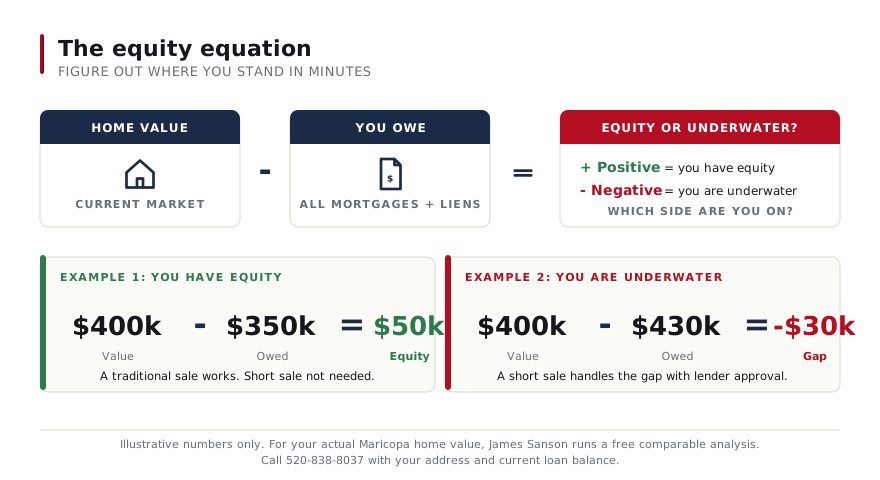
Visual of the home equity formula with two example scenarios showing positive equity and an underwater position
The equity formula at work. Two example scenarios show what positive equity and underwater positions look like.

The basic equation

The fundamental equation for home equity is:

Home Equity = Market Value − Total Debt Secured by Property

If the result is positive, you have equity. If the result is zero, you are at break-even. If the result is negative, you are underwater by that amount.

Two examples to set the frame:

  1. Home worth $340,000, one mortgage with a $295,000 balance, no second mortgage or HELOC. Equity = $340,000 minus $295,000 = $45,000 of equity. Not underwater.
  2. Home worth $290,000, one mortgage with a $315,000 balance, no other debt. Equity = $290,000 minus $315,000 = negative $25,000. Underwater by $25,000.

The math is easy. Getting accurate numbers for both sides of the equation is where most homeowners go wrong.

Step 1: Find your accurate market value

The market value is the single most important variable and also the most often misjudged. The number you paid for the home, the number you refinanced at, the Zillow Zestimate, and the property tax assessor's valuation are all related to but different from the current market value.

Sources of market value, ranked roughly by accuracy:

  1. Comparative Market Analysis (CMA) from a local Realtor. Typically, the most accurate for an unsold home. A Realtor pulls recent sales of comparable homes in your immediate area and adjusts for differences in size, condition, and features, as well as current listings or pending sales. Free in most cases. We provide CMAs for Maricopa homeowners at no cost.
  2. Licensed appraisal. The most rigorous valuation is used for lending and tax purposes. Typically costs $400-$700. Worth it if you have a high-stakes decision pending and want the most defensible number.
  3. Online valuation tools. Zillow Zestimate, Redfin Estimate, and Realtor.com estimates. Useful as starting points. Generally accurate within 5 to 15 percent in either direction, but in unusual properties or rapidly-moving markets, they can be substantially further off. Treat it as a rough range, not a precise number.
  4. Property tax assessor valuation. Generally tied to a different methodology than market value, and often significantly different. Useful for tax purposes, less useful for "what would my home sell for today" questions.
  5. Recent purchase price. Useful only if the home was purchased very recently and market conditions have not meaningfully changed. Otherwise outdated.

For most Maricopa homeowners doing this calculation seriously, the CMA from a Realtor is the right starting point. The CMA accounts for neighborhood-level differences within Maricopa (a home in Province has a different market dynamic than a similar home in Senita) that online estimates often miss.

Step 2: Add up all the debts secured by the property

The debt side of the equation includes everything that must be paid off when the home sells. This is more than just your primary mortgage.

Components to include:

  1. Primary mortgage balance. The current principal balance, not the original loan amount. Pull from your most recent mortgage statement. Use the "current balance" or "principal balance" line, not "scheduled balance" or "payoff amount as of next due date" (those slightly differ).
  2. Second mortgage or junior loan balance. If you have a second mortgage, include its current balance. These are often forgotten because they may be with a different lender and have separate statements.
  3. HELOC balance. A home equity line of credit counts even if you have not drawn on it recently. Include the current outstanding balance. If you have an open HELOC with a zero balance, the line itself does not count, but the existence may complicate a sale because the lender may still have a lien on the title until the line is formally closed.
  4. Tax liens. Unpaid property taxes, IRS liens, or state tax liens are recorded against the property.
  5. Judgment liens. Court judgments that have been recorded against the property.
  6. HOA arrears liens. Past-due HOA dues that have been recorded as a lien on the property.
  7. Mechanic's liens. Unpaid contractor or repair bills that have been recorded.

If you are not sure whether any liens exist beyond your mortgages, a title search through a title company can give you a definitive list. Most title companies charge $100 to $200 for this, and it is worth doing if you suspect anything unusual or if you are seriously evaluating a sale.

Step 3: Account for selling costs

This is the step most homeowners skip, and it changes the answer meaningfully. The market value of the home is what a buyer would pay. The amount that arrives at the closing table to pay off your loans is the market value minus selling costs.

Typical selling costs for a Maricopa home include:

  1. Real estate commissions. Typically, 5 to 6 percent of the total sale price is paid from the sale proceeds. This is the largest single selling cost.
  2. Title insurance and escrow fees. Roughly 1 percent of the sale price, depending on the title company and the specific policies.
  3. Transfer fees and recording fees. A few hundred dollars typically.
  4. Prorated property taxes. Depending on when in the tax year the sale closes.
  5. HOA transfer fees. Varies by HOA, often $200 to $500.
  6. Repair costs or buyer concessions. Often negotiated as part of the sale, it can range from zero to several thousand dollars.

For most Maricopa sales, total selling costs run roughly 7 to 9 percent of the sale price. So if your home sells for $300,000, expect roughly $24,000 to $27,000 in selling costs, leaving roughly $273,000 to $276,000 to pay off loans.

This matters because a home that is "even" on the basic equation (market value equals loan balance) is actually underwater by the amount of selling costs. A home worth $300,000 with a $300,000 mortgage balance is, for practical purposes, $24,000 to $27,000 underwater when you account for the cost of selling.

Step 4: Do the math

With accurate inputs gathered, do the calculation:

  1. Start with a realistic market value
  2. Subtract estimated selling costs (roughly 7 to 9 percent of market value)
  3. The result is your estimated net proceeds at closing
  4. Subtract total debt secured by the property (primary mortgage + second mortgage + HELOC + liens)
  5. The final result is your effective equity (positive) or underwater gap (negative)

This calculation gives you the practical answer to "if I sold today, how much would I walk away with, or how much would I have to bring to close?" That is usually the question that matters.

Worked examples for Maricopa homeowners

Three illustrative scenarios using realistic Maricopa numbers:

Example 1: Modestly positive equity

  1. Home market value (CMA): $340,000
  2. Estimated selling costs (8%): $27,200
  3. Net proceeds estimate: $312,800
  4. Primary mortgage balance: $285,000
  5. HELOC balance: $0 (closed)
  6. Liens: none
  7. Equity position: $27,800 positive

This homeowner could sell normally and walk away with roughly $27,800 after costs and loan payoff. Not a lot of cash, but not underwater. A normal sale works.

Example 2: Underwater after selling costs

  1. Home market value (CMA): $310,000
  2. Estimated selling costs (8%): $24,800
  3. Net proceeds estimate: $285,200
  4. Primary mortgage balance: $305,000
  5. HELOC balance: $0
  6. Liens: none
  7. Equity position: $19,800 negative

The home appears "above water" on the basic equation ($310,000 in value vs. $305,000 owed), but after accounting for the cost of selling, the homeowner would need to bring roughly $19,800 to the closing table to pay off the loan. This is the classic situation where the homeowner does not realize they are practically underwater.

Example 3: Significantly underwater with a second mortgage

  1. Home market value (CMA): $295,000
  2. Estimated selling costs (8%): $23,600
  3. Net proceeds estimate: $271,400
  4. Primary mortgage balance: $290,000
  5. Second mortgage balance: $38,000
  6. Liens: none
  7. Equity position: $56,600 negative

This homeowner is underwater by roughly $56,600 in real terms. A normal sale will not work without bringing significant cash. Short sale is likely the path if selling is necessary.

Common mistakes that produce wrong numbers

Several recurring errors lead to inaccurate equity calculations:

  1. Using the original purchase price instead of the current market value. Maricopa values have moved substantially in either direction during various periods. Yesterday's purchase price is not today's market value.
  2. Treating the Zillow Zestimate as authoritative. Zillow estimates are useful starting points but can be 10 to 20 percent off in either direction on individual properties. Especially unreliable for homes with unique features, recent renovations, or in micro-markets within Maricopa.
  3. Forgetting about selling costs. The most common error. A home that appears even on basic numbers is typically underwater by 7 to 9 percent in practical terms.
  4. Forgetting about a HELOC or second mortgage. Particularly common when the second loan was opened years ago, and the homeowner has not actively used it. The lien is still there.
  5. Using the original loan amount instead of the current principal balance. Several years of payments reduce the balance. Use the current statement, not the closing documents from the original loan.
  6. Ignoring the property tax assessor as totally irrelevant. Tax assessor valuation is a different methodology, but if it is dramatically different from your CMA estimate, that is worth investigating. Sometimes the assessor catches things that online estimates miss.
  7. Comparing only to homes that recently sold for high prices. Cherry-picking the best comparable sales overestimates value. A realistic CMA uses a balanced set of recent sales, current listings, and pending sales.
  8. Forgetting about the property condition. A home with deferred maintenance, an outdated kitchen, or a failing roof sells for less than a comparable home in better condition. Online estimates do not see the condition.

What to do with the answer

Once you have a realistic equity number, what to do next depends on which range you are in:

  1. Comfortable positive equity (over $30,000). If you need or want to sell, a normal sale works. List the home and proceed normally.
  2. Modest positive equity ($0 to $30,000 after costs). A normal sale works but produces limited cash in your hand. Consider whether the timing is right.
  3. Slightly underwater (under $20,000). Bringing cash to close is feasible for many homeowners. Compare against the alternative of a short sale and its credit consequences.
  4. Meaningfully underwater ($20,000 to $80,000). Cash-to-close becomes harder. Short sale becomes the realistic exit path if you need to sell. See the short sale process explained for the walkthrough.
  5. Significantly underwater (over $80,000) or have multiple liens. A short sale is typically the realistic exit. The complexity of multiple liens may also be relevant. See selling with no equity for the broader option set.

If your situation involves life circumstances that are forcing the sale (rather than choosing to sell), see options when payments are too much, selling an underwater home in divorce, or options after losing your job for situation-specific guidance.

Important.This page provides general guidance on calculating home equity for Maricopa homeowners. Your specific situation may have legal, tax, or financial dimensions that require professional advice. For questions about lien priority or title issues, consult a title company or Arizona-licensed attorney. For tax implications of selling, consult a CPA. The numbers above are illustrative, not predictive of your specific home's value or outcome.

If you want accurate numbers on your Maricopa home from someone who works with these calculations every day, call 520-838-8037. We provide free comparative market analyses with no obligation. The conversation typically takes about 30 minutes. You will walk away with a realistic value range, an estimate of what you would net after costs, and clarity about whether you are underwater. For a broader context on what underwater means and what your options are, see selling an underwater home. Maricopa short sale specialists with over two decades of experience helping homeowners through these decisions.

Tell us about your situation

No pressure, no obligation, no charge. James will call you back personally to discuss your options. For faster help, call 520-838-8037.

Before you submit

You may stop doing business with us at any time. You may accept or reject the offer of mortgage assistance we obtain from your lender. If you reject the offer, you do not have to pay us. If you accept the offer, you will pay us based on the agreed listing terms.

The James Sanson Team is not associated with the government, and our service is not approved by the government or your lender.

Even if you accept this offer and use our service, your lender may not agree to change your loan.

James Sanson | Real Broker LLC | Licensed in Arizona

Conversations are confidential and carry no obligation. Not legal, tax, or financial advice. For impartial mortgage assistance counseling, contact a HUD-approved housing counselor at hud.gov.

Licensed since August 2002 Maricopa focus since 2004 Short sale experience since 2008 FastExpert 2026 Top Agent

Frequently asked questions

How accurate is the Zillow Zestimate for figuring out if I'm underwater?
Zillow estimates are useful as starting points but typically have a margin of error of 5 to 15 percent in either direction for individual homes. For unique properties, recently renovated homes, or homes in micro-markets within Maricopa, the error can be larger. Use Zillow as a rough range, not a precise number. For a serious equity calculation, get a Realtor's comparative market analysis or a licensed appraisal.
Does the property tax assessor's value tell me what my home is worth?
Not directly. The assessor's valuation uses a different methodology than market valuation, and the two often differ significantly. In Arizona, the assessor's value is used for property tax calculation and is not designed to reflect what your home would sell for today. Use it as one data point among several, not as the answer.
Do I need to include selling costs when figuring out if I'm underwater?
For practical purposes, yes. The amount that would pay off your mortgage at closing is the sale price minus selling costs (typically 7 to 9 percent of the sale price for a Maricopa home). A home with a $300,000 mortgage that would sell for $310,000 looks above water on a basic equity calculation but is actually underwater in practical terms by roughly $14,000 to $17,000 after selling costs. Always include selling costs in your real-world calculation.
Does my HELOC count if I haven't used it in years?
If the HELOC has a current balance, yes, it counts. If the line is open with a zero balance, the balance itself does not affect your equity calculation, but the existence of the open line may still complicate a sale because the lender may have a lien on the title until the line is formally closed. If you have an open HELOC with a zero balance and are seriously evaluating a sale, talk to that lender about formally closing the line.
How often should I recalculate my home equity?
For most homeowners not actively planning a sale, once a year is fine. Pull a Realtor's CMA or check online estimates against your current mortgage statement once annually to get a rough sense of where you stand. If you are anticipating a sale (planned move, expected job change, retirement) or experiencing a financial change, recalculate more often. Maricopa values can shift meaningfully over a six-month period, so up-to-date numbers matter when a decision is pending.
What if I disagree with the CMA my Realtor gives me?
A CMA is one professional's opinion based on the comparable sales data available. Different Realtors may produce different CMAs for the same home, particularly in markets with few recent comparable sales or when the home has unique features. If you disagree, you can request CMAs from additional Realtors, hire a licensed appraiser for a more rigorous valuation (typically $400 to $700), or list the home at a price you believe is justified and let the market respond. For decisions with significant financial consequences, getting a second opinion is reasonable.
Can I do this calculation without involving a Realtor?
Yes. You can use online estimates (Zillow, Redfin, Realtor.com) for market value, pull your mortgage statement for the loan balance, and estimate selling costs at roughly 8 percent of value. This gives you a rough range. For a tighter number, a Realtor's CMA is more accurate, and most Realtors provide them at no cost. For decisions with significant financial consequences, the more accurate calculation is worth the time.

Talk to a Maricopa specialist today

Whether you're buying, selling, or just exploring, call us. No obligation.

520-838-8037

James Sanson | Real Broker LLC | Licensed in Arizona

Talk to a Maricopa short sale specialist

Call 520-838-8037 right now, or fill out the form and we will reach out within one business day.

Before you submit

You may stop doing business with us at any time. You may accept or reject the offer of mortgage assistance we obtain from your lender. If you reject the offer, you do not have to pay us. If you accept the offer, you will pay us based on the agreed listing terms.

The James Sanson Team is not associated with the government, and our service is not approved by the government or your lender.

Even if you accept this offer and use our service, your lender may not agree to change your loan.

James Sanson | Real Broker LLC | Licensed in Arizona

Conversations are confidential and carry no obligation. Not legal, tax, or financial advice. For impartial mortgage assistance counseling, contact a HUD-approved housing counselor at hud.gov.