

James Sanson
Lead Short Sale Negotiator
Licensed since August 2002, Maricopa focus since 2004. Handles every short sale on this site personally.
Lead Short Sale Negotiator
Licensed since August 2002, Maricopa focus since 2004. Handles every short sale on this site personally.

Buyer Specialist
7 years in Maricopa. Works with buyers writing offers on our short sale listings. Patient, thorough, answers the phone.

Bilingual Buyer Specialist
Habla espanol. 8 years experience. Works with buyers across 85138 and 85139 on our short sale listings.
In most Maricopa short sales the seller pays nothing out of pocket. Here is when that holds, when it does not, and how to know which applies to you.
Real Broker LLC · Licensed in Arizona
If you are facing a short sale on your Maricopa home, one of the first questions on your mind is probably the simplest one: What is this going to cost me? It is a fair question, and the answer is more reassuring than most people expect. In the majority of Maricopa short sales, the seller pays nothing out of pocket. This page explains how short sale costs work, who pays them, and the specific situations in which a seller might be asked to contribute.
Quick answer: In most Maricopa short sales, the seller pays nothing out of pocket. Real estate commissions, title and escrow fees, and standard closing costs are typically paid from the sale proceeds, with your lender approving those deductions as part of the short sale terms. A seller may be asked to contribute in specific cases, such as a second mortgage or HELOC, or certain conventional loan programs. We review every potential cost with you before listing. Call 520-838-8037 to talk through your situation.
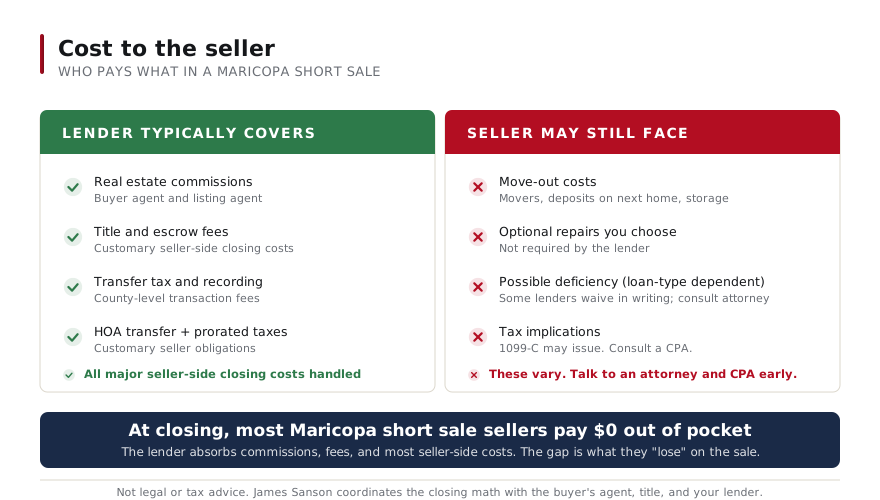
In a traditional sale, the seller pays closing costs out of their equity. A short sale works differently because there is no equity left to draw from. Instead, the costs of selling are paid from the sale proceeds before the lender receives what remains, and the lender agrees to accept that smaller net amount as part of approving the short sale.
In practical terms, this means the lender absorbs the standard transaction costs rather than the seller writing checks. The lender does this because the alternative, taking the home back through foreclosure and selling it themselves, usually costs them more. Understanding this trade-off is part of the Maricopa short sale process, and it is the reason most sellers leave the closing table without paying anything out of pocket.
When your lender reviews the offer and the closing statement, they approve a set of standard deductions from the proceeds. These usually include:
The lender reviews each line item and decides what they will accept. This is one reason the offer package and closing statement have to be prepared carefully. If you want to see what the lender looks for at this stage, read about how lender approval works and the documents you need for a short sale.
While most sellers pay nothing, there are situations in which a contribution is required. The most common is a second mortgage or HELOC. The second lien holder receives far less than they are owed in a short sale, and they sometimes ask the seller for a modest cash contribution or a small unsecured promissory note in exchange for releasing the lien.
Certain conventional loan programs backed by Fannie Mae or Freddie Mac may also request a seller contribution toward the shortfall, depending on your financial situation and whether you are current on payments. These requests are not universal, and they are often negotiable. The key is that you will know about any potential contribution before you list, not at the closing table. Each situation is different, and we will tell you what your specific lender and loan type are likely to require.
If you are not sure whether a contribution applies to your loan, the fastest way to find out is to ask. Call 520-838-8037, and we will look at your specific situation.
Be cautious of any company that asks you to pay a fee before your lender has accepted a short sale offer. Charging advance fees for mortgage assistance relief work is restricted under federal rules, and a legitimate real estate team does not collect from you before the work produces a result your lender has accepted.
The James Sanson Team is paid through the commission from the sale proceeds, the same way any listing is paid, and only if the sale closes. We are not associated with the government, and our service is not approved by the government or your lender. If anyone promises a result in exchange for an upfront payment, treat that as a warning sign and consider speaking with a HUD-approved housing counselor for impartial guidance at hud.gov.
The out-of-pocket cost is only one part of the picture. A short sale affects your credit, though typically less than a foreclosure, and the exact impact depends on whether you were behind on payments and how the settled debt is reported. You can read more about how a short sale affects your credit to set realistic expectations.
There can also be tax consequences. The IRS may treat forgiven mortgage debt as taxable income, although exceptions such as the Mortgage Forgiveness Debt Relief Act and insolvency exclusions may apply. Separately, Arizona has anti-deficiency protections under A.R.S. 33-729 and A.R.S. 33-814 that may limit a lender's ability to pursue you for a shortfall on certain qualifying properties. These are legal and tax questions, not real estate questions. We are licensed Arizona REALTORS, not attorneys or CPAs, so review the tax implications of a short sale with a licensed CPA and any deficiency questions with a licensed Arizona attorney.
Every short sale is a little different, so the only way to know your full picture is to walk through your loan type, lien situation, and timeline together. In a short, confidential phone call, we can tell you whether you are likely to pay anything at all, and if so, roughly what to plan for. We will not surprise you with closing costs.
When you are ready, call 520-838-8037 for a quiet, no-pressure conversation, or reach our team of Maricopa short sale specialists through the form on this page. If you want to understand what happens after your lender approves the sale, see the closing timeline.
No pressure, no obligation, no charge. James will call you back personally to discuss your options. For faster help, call 520-838-8037.
James personally handles every short sale on this site. David Hoos and David Ruiz are buyer specialists who help when our short sale listings need buyers.
Listing Specialist, Lead Short Sale Negotiator
Licensed Arizona REALTOR since August 2002, focused on Maricopa since 2004. 1,000+ closings. Built the short sale practice during the 2008-2012 downturn. Personally manages every short sale file on this site.
Buyer Specialist
7 years in Maricopa. Works with buyers, including those writing offers on our short sale listings. Patient, thorough, answers the phone.
Bilingual Buyer Specialist
Habla espanol. 8 years experience. Works with buyers across 85138 and 85139, including those writing offers on our short sale listings.
Whether you're buying, selling, or just exploring, call us. No obligation.
520-838-8037James Sanson | Real Broker LLC | Licensed in Arizona
Call 520-838-8037 right now, or fill out the form and we will reach out within one business day.