

James Sanson
Lead Short Sale Negotiator
Licensed since August 2002, Maricopa focus since 2004. Handles every short sale on this site personally.
Lead Short Sale Negotiator
Licensed since August 2002, Maricopa focus since 2004. Handles every short sale on this site personally.

Buyer Specialist
7 years in Maricopa. Works with buyers writing offers on our short sale listings. Patient, thorough, answers the phone.

Bilingual Buyer Specialist
Habla espanol. 8 years experience. Works with buyers across 85138 and 85139 on our short sale listings.
What the lender reviews, what they ask for, and how long approval typically takes across FHA, VA, conventional, and portfolio loans.
Real Broker LLC · Licensed in Arizona
Short sale lender approval is the loss mitigation department's review of your hardship, the buyer's offer, and the property's market value. Approval typically takes 60 to 120 days from package submission. Lenders approve when the math shows they will net more from the short sale than from foreclosure. A BPO or appraisal step is standard. Counters for higher price or seller contribution are common and often negotiable.
Once you have an accepted offer on your Maricopa short sale, the file goes to your lender's loss mitigation department. What happens next is the part of the process most homeowners find opaque. This page walks through exactly what your lender does with your file, what they are looking for at each step, what the BPO and underwriting review actually involve, and what your approval letter will say. Once you know how the inside of the process works, the wait gets easier to handle.
If you want a sharper read on what your specific lender is likely to do, call 520-838-8037. We have submitted Maricopa short sale packages to every major servicer and many smaller ones. Each lender has patterns.
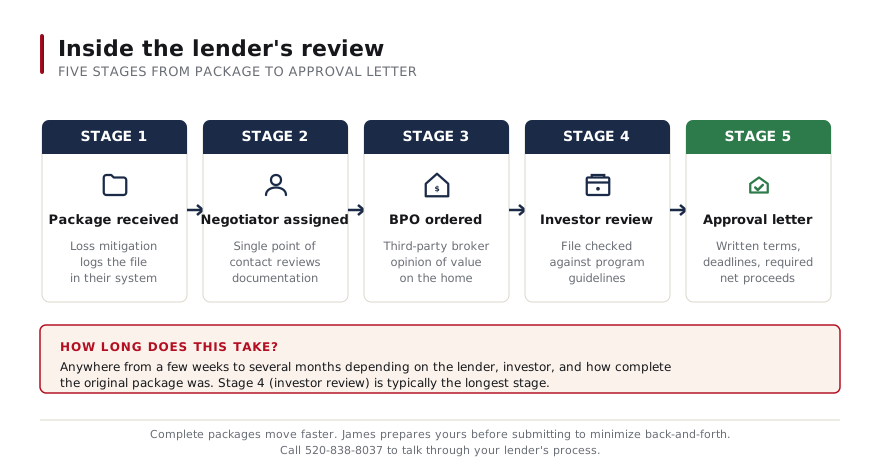
Lenders are not deciding whether to be generous to you. They are running a math problem. The loss mitigation department compares two numbers: what they would net from approving your short sale, and what they would net from foreclosing and reselling the property themselves. If the short sale number is higher, they approve. If foreclosure looks better on paper, they decline or counter for terms that close the gap.
Three things drive that math. The first is the offered price compared to the property's market value (the BPO step exists to verify this). The second is the cost the lender will incur to foreclose, which in Arizona includes trustee sale fees, holding costs, eviction if needed, repairs, and resale commissions. The third is your demonstrated hardship and lack of significant assets the lender could otherwise pursue. The stronger your hardship file and the closer the offer is to market value, the cleaner the approval math.
Two factors are not on the list: how nice you are, and how much you need this to work. Loss mitigation reviewers are processing dozens of files at a time. The package speaks for you, not your tone in emails. We build packages with that reality in mind.
The lender review begins when the complete package arrives in loss mitigation. "Complete" matters. Incomplete packages get bounced or set aside, and every round-trip adds days or weeks. The submission package typically includes your hardship letter and hardship documentation, recent pay stubs or income proof, two years of tax returns, two to three months of bank statements, a financial worksheet listing assets and liabilities, the executed purchase contract, the buyer's proof of funds or pre-approval letter, the listing agreement, and the preliminary HUD-1 or settlement statement.
For a deeper look at exactly what your specific lender wants, see documents you need for a short sale. We put the file together with you, double-check it for completeness before submission, and follow the exact submission protocol your lender uses (some have proprietary portals like Equator, others use email or fax).
Within a few weeks of submission, the lender orders an independent valuation. For most short sales this is a Broker Price Opinion (BPO), performed by a local Realtor the lender contracts with. For some loan types and higher-value properties, the lender orders a full appraisal instead. Either way, the goal is the same: confirm the home's market value to the lender's satisfaction, independent of what your listing agent says.
The valuation result is the single biggest swing factor in approval. If the BPO comes in close to the offer price, the rest of the review usually goes smoothly. If the BPO comes in higher than the offer, the lender will often counter for a higher price, or reject the offer outright. If the BPO comes in lower than the offer (rare but it happens), the lender may approve quickly because the offer suddenly looks generous to them.
If we believe the BPO is wrong, we can dispute it. The process involves submitting recent comparable sales that support a lower valuation, photos showing condition issues, and any other evidence (HOA fees, deferred maintenance, location concerns). BPO disputes succeed often enough to be worth pursuing when warranted, but they add 2 to 4 weeks to the timeline.
Once the lender has a value in hand, loss mitigation underwrites the deal. This phase looks similar to mortgage underwriting on a new loan, except the question is different. The underwriter is verifying that your hardship is documented and credible, that your financial picture makes a short sale appropriate (rather than a loan modification), that the buyer is real and capable of closing, that the proposed net to the lender is acceptable under the loan's investor guidelines, and that all closing costs and commissions are within the lender's allowable schedule.
Investor guidelines matter here. Even if your servicer is willing to approve, the loan's actual owner (Fannie Mae, Freddie Mac, a private investor, or the lender itself) has rules the servicer must follow. Fannie Mae and Freddie Mac publish their short sale servicing guidelines publicly. FHA loans follow a structured HUD program. VA loans follow the Department of Veterans Affairs Compromise Sale rules. The strength of your hardship documentation, prepared earlier through your short sale hardship letter, is what carries you through underwriting.
Once underwriting completes, you get one of three outcomes. The lender approves the deal as submitted and issues an approval letter. The lender counters with different terms and asks for a response within a stated window. The lender declines, often with a reason you can address in a resubmission.
An approval letter is a binding document with specific contents. It states the minimum net the lender will accept from the sale, the date by which the deal must close (typically 30 to 60 days after the letter is issued), the buyer of record (so you cannot substitute a different buyer without resubmitting), any required seller contribution or promissory note for the deficiency, and any other conditions that must be satisfied before closing (insurance, occupancy, repairs).
The closing deadline matters. If the deal does not close by the deadline stated in the letter, the approval expires. Most lenders will extend with a new submission, but some will not, and the extension process can take weeks. We track the deadline from the day the letter is issued and keep the buyer's loan team moving accordingly.
Counters are common, especially on the first submission. The lender wants a higher price, or asks you to contribute toward the deficiency, or wants a promissory note for some portion of the shortfall. None of those are automatic deal-killers. Counters are the lender's opening position in a negotiation, and the response matters.
Some counter terms are negotiable. A higher price ask, for instance, can sometimes be met by going back to the buyer for a small increase, or by disputing the BPO that drove it. Other terms reflect investor rules and are not flexible (a required promissory note on certain loan types is sometimes mandatory regardless of the homeowner's preference). We tell you up front which is which, then respond to the lender within the counter response window.
If the buyer walks during a counter cycle (it happens, especially on long counters that test patience), the file goes back to the market with the listing reactivated. The lender's prior review work usually transfers to a new offer, so the second submission moves faster than the first.
The five steps above describe the general arc, but the specifics shift based on what kind of loan you have. FHA loans go through HUD's Pre-Foreclosure Sale program, which has clear paperwork requirements, a structured timeline, and pre-defined seller financial incentives in some cases. VA loans use the Department of Veterans Affairs Compromise Sale program, which requires VA approval on top of your servicer's. USDA loans follow USDA Rural Development rules.
Conventional loans backed by Fannie Mae and Freddie Mac follow agency loss mitigation guidelines, with timelines and counter patterns that vary by servicer but cluster around agency norms. Portfolio loans held by the originating lender (not sold to an agency) have the most variable process because the lender writes its own rules. For the full breakdown of how each loan program handles short sales, see the short sale process for your loan type.
Identifying your loan type early matters. The wrong assumption about which program applies can lose weeks. We confirm loan ownership before drafting the submission strategy.
Approval files stall for predictable reasons. The most common is missing or inconsistent documentation. The lender requests one more bank statement, one more pay stub, one more clarification, and the file sits while the next round of paperwork arrives. We pre-empt this by submitting more documentation than strictly required and keeping a checklist of what each lender historically asks for.
The second common stall is BPO disputes. The lender's value comes in too high, we dispute it, and the dispute takes weeks to resolve. We manage this by selecting comparable sales aggressively at the dispute submission and following up regularly.
The third stall is investor escalation. When the servicer cannot decide alone and has to escalate to the investor (Fannie, Freddie, FHA, VA), an extra approval layer adds time. We cannot speed that up but we can identify when it is happening and reset your expectations accordingly. If you have already received a Notice of Trustee Sale and time is short, see what a Notice of Default means and call 520-838-8037 right away.
The questions below come up in nearly every Maricopa short sale conversation. For impartial guidance before talking with us, you can request a free housing counselor through HUD at no cost. To talk through your situation directly, reach out to James Sanson short sale specialists or read about the Maricopa short sale process from start to finish, plus the typical short sale timeline for context on where lender approval fits in the larger arc. Call 520-838-8037 to get started.
No pressure, no obligation, no charge. James will call you back personally to discuss your options. For faster help, call 520-838-8037.
James personally handles every short sale on this site. David Hoos and David Ruiz are buyer specialists who help when our short sale listings need buyers.
Listing Specialist, Lead Short Sale Negotiator
Licensed Arizona REALTOR since August 2002, focused on Maricopa since 2004. 1,000+ closings. Built the short sale practice during the 2008-2012 downturn. Personally manages every short sale file on this site.
Buyer Specialist
7 years in Maricopa. Works with buyers, including those writing offers on our short sale listings. Patient, thorough, answers the phone.
Bilingual Buyer Specialist
Habla espanol. 8 years experience. Works with buyers across 85138 and 85139, including those writing offers on our short sale listings.
Whether you're buying, selling, or just exploring, call us. No obligation.
520-838-8037James Sanson | Real Broker LLC | Licensed in Arizona
Call 520-838-8037 right now, or fill out the form and we will reach out within one business day.