

1,000+ Closings 267 Five-Star Reviews FastExpert 2026 Top Agent
James Sanson, REALTOR

James Sanson

Lead Short Sale Negotiator

Licensed since August 2002, Maricopa focus since 2004. Handles every short sale on this site personally.

David Hoos, REALTOR

David Hoos

Buyer Specialist

7 years in Maricopa. Works with buyers writing offers on our short sale listings. Patient, thorough, answers the phone.

David Ruiz, REALTOR

David Ruiz

Bilingual Buyer Specialist

Habla espanol. 8 years experience. Works with buyers across 85138 and 85139 on our short sale listings.

How Your Loan Type Changes the Maricopa Short Sale Process

VA, FHA, conventional, USDA, and second mortgages each follow different rules. Pick yours and see exactly what to expect.

Real Broker LLC · Licensed in Arizona

By James Sanson, REALTOR. Licensed Arizona REALTOR since August 2002. Maricopa specialist since 2004. 1,000+ closings. Seethe team's short sale credentials.
Published May 16, 2026 · Updated May 16, 2026
Quick answer

The short sale process is broadly similar across loan types, but specific rules vary significantly. VA loans use a process called Compromise Sale with its own VA-administered framework. FHA loans use HUD's Pre-Foreclosure Sale program, which has specific eligibility and approval steps. Conventional loans (Fannie Mae and Freddie Mac) have separate servicing guides. USDA loans follow yet another program structure. Second mortgages and HELOCs add complexity to any short sale because the junior lienholder must agree separately. Knowing your loan type matters because it determines which rules, timelines, and approval processes apply. Call 520-838-8037 to talk through your specific situation.

If you are considering a short sale on a home in Maricopa, one of the first questions to answer is: What kind of loan do you have? The answer affects nearly everything that comes next. Different loan programs have different short-sale frameworks, approval processes, documentation requirements, and timelines. A VA loan short sale is fundamentally different from a conventional short sale, and an FHA short sale runs through a different process than either. Knowing what you have shapes your expectations and helps your agent submit the right documentation properly.

This page provides an overview of the major loan types and how short sales work under each. Each loan type also has its own dedicated page with more detailed technical information. The James Sanson Team has handled short sales across all major loan types since 2004 and has closed over 1,000 short sales in the Maricopa market. Call 520-838-8037 to talk through your specific situation, with no obligation.
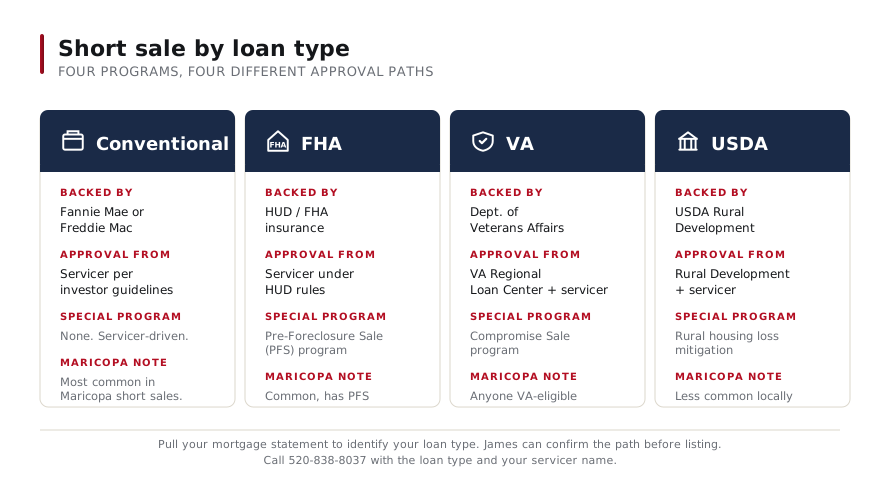
Comparison grid of VA, FHA, USDA, conventional, and second mortgage or HELOC loan types for Maricopa short sales
Five short sale loan types and the key feature that distinguishes each one.

Why your loan type matters

The short sale process is broadly similar across loan types: financial hardship is documented, the home is listed, a buyer's offer is submitted to the lender, the lender reviews and approves it, and the sale closes. But within that general framework, the specific rules differ in ways that affect the homeowner directly:

  1. Approval authority is different. Some loan types require approval from the federal agency that insures or guarantees the loan, not just the servicer. VA loans require VA approval. FHA loans require HUD approval. Conventional loans require the investor (typically Fannie Mae or Freddie Mac) to approve through their servicing guides.
  2. Documentation requirements differ. Each agency or program has its own required forms. VA uses a specific Compromise Sale package. FHA has its own Pre-Foreclosure Sale documentation. Conventional loans use lender-specific forms that follow Fannie/Freddie guidelines.
  3. Timelines vary. Some programs are faster than others. Some involve additional steps before a sale can proceed.
  4. Deficiency treatment varies. How the unpaid balance is handled (waived, settled, pursued) depends on the loan type and the specific approval letter.
  5. Future loan qualification timing varies. Waiting periods to qualify for a new mortgage differ by loan program, with VA generally allowing the fastest path back and conventional often taking the longest.

This is why an agent who has handled short sales across loan types is more useful than one who has only worked with a single type. The technical patterns matter. Call 520-838-8037 if you want to talk through how the process will work for your specific loan type.

How to identify your loan type

If you are not sure what kind of loan you have, here is how to find out:

  1. Check your most recent mortgage statement. The loan type is often listed in the account details or on the first page summary.
  2. Look at your closing documents. The deed of trust and mortgage note typically identify the loan program.
  3. Call your servicer. The loss mitigation or customer service department can tell you exactly what type of loan you have.
  4. Look at the closing disclosure or HUD-1. These settlement documents from your original loan often identify the loan program directly.
  5. Check the VA, FHA, or USDA case number. If your loan is government-backed, there is typically a case number in your closing documents. The number format indicates the loan type.

If you bought the home recently and used a down payment assistance program, financing structure, or unusual loan product, the loan type may not be obvious. When in doubt, call the servicer directly.

VA loans (Compromise Sale)

If your mortgage is a VA loan (typical for eligible service members, veterans, and surviving spouses), the short sale process is technically called a "Compromise Sale" by the Department of Veterans Affairs. The VA reviews and approves the sale even though your servicer handles most of the day-to-day administration.

Key VA Compromise Sale characteristics:

  1. VA approval required. The Department of Veterans Affairs must approve the sale terms in addition to your servicer's review. This is typically handled by the servicer submitting the package to the VA, but the VA's involvement adds steps and time.
  2. Eligibility documentation. The VA looks for documented hardship and a Maricopa home value that supports the submitted offer. The VA typically orders its own appraisal or has the servicer value the property.
  3. Generally favorable waiting period to requalify. VA loan short sales generally allow the borrower to qualify for a new VA loan within approximately 2 years, faster than most other loan programs.
  4. VA entitlement considerations. A Compromise Sale may affect your VA loan entitlement (the amount of VA backing you can use on future loans). Specific implications should be discussed with your servicer and a licensed Arizona mortgage loan officer experienced with VA loans.
  5. Deficiency treatment. The VA's framework typically addresses any deficiency in the Compromise Sale approval. Specifics vary by case.

For a deeper walkthrough of how VA Compromise Sales work specifically, see the VA Compromise Sale process. The official VA framework is documented at benefits.va.gov.

FHA loans (Pre-Foreclosure Sale)

FHA loans (insured by the Federal Housing Administration through HUD) use a process called the Pre-Foreclosure Sale (PFS) program for short sales. The PFS program is structured by HUD and administered through your servicer.

Key FHA PFS characteristics:

  1. HUD-defined eligibility. Borrowers must meet specific FHA criteria, including documented hardship, occupancy of the property as a primary residence, and inability to maintain the mortgage payment.
  2. Approval to participate. The borrower typically applies to enter the PFS program before listing the home. Approval is then issued for a defined marketing period (commonly 4 to 6 months).
  3. Minimum acceptable offer. FHA sets a minimum percentage of appraised value that the offer must meet. The percentage typically increases the longer the home is on the market.
  4. Generally, a 3-year waiting period to requalify. Borrowers completing an FHA PFS generally need to wait approximately 3 years before qualifying for a new FHA loan, though the wait may be shorter with documented extenuating circumstances.
  5. Deficiency typically waived. The PFS program structure typically includes a release from further obligations on the loan once the sale is complete, per HUD requirements.

For the detailed FHA short sale walkthrough, see FHA Pre-Foreclosure Sale. The official FHA short sale framework is documented in HUD's Single Family Housing Policy Handbook (4000.1). Specific details and updates are available at hud.gov.

Conventional loans (Fannie Mae / Freddie Mac)

The majority of conventional mortgages in the United States are owned by Fannie Mae or Freddie Mac or follow their underwriting standards. Each maintains its own servicing guide that governs short sales on its loans. Servicers follow these guides when reviewing short sale applications.

Key conventional short sale characteristics:

  1. Servicer is the primary contact. Unlike VA and FHA loans, where the agency directly reviews, conventional short sales typically go through the servicer following Fannie or Freddie guidelines without separate agency-level approval.
  2. Investor approval may be required. Some conventional loans are owned by private investors rather than Fannie or Freddie, in which case investor approval is required and may follow different rules.
  3. Documentation through the servicer. Standard short-sale package: hardship letter, financial documentation, listing agreement, buyer's offer.
  4. Waiting periods vary by program and circumstances. Generally, 2 to 4 years to requalify for a new conventional loan after a short sale, depending on down payment, documented extenuating circumstances, and current guidelines.
  5. Deficiency treatment varies. The lender's approval letter typically addresses the deficiency. Most conventional short sale approval letters waive the deficiency, but this is not universal.

For the detailed conventional short-sale walkthrough, see the conventional loan short sale. The Fannie Mae and Freddie Mac servicing guides are publicly available at singlefamily.fanniemae.com and sf.freddiemac.com. Specific guidelines are subject to updates over time.

USDA loans

USDA loans (Rural Development loans, backed or directly held by the U.S. Department of Agriculture) have their own short-sale framework. Maricopa, despite its proximity to Phoenix, has historically had areas that qualified for USDA financing.

Key USDA short sale characteristics:

  1. USDA approval is generally required. Like VA loans, USDA-backed loans typically require agency approval in addition to servicer review.
  2. Documentation through the Rural Development guidelines. USDA has its own specific requirements that the servicer typically packages and submits.
  3. Approximately a 3-year waiting period to requalify. Borrowers completing a USDA short sale generally need to wait approximately 3 years before qualifying for a new USDA loan.
  4. Less common than VA, FHA, or conventional. The volume of USDA short sales is lower, so fewer agents have direct experience with them. The mechanics are similar to those of other agency loans, but the specific paperwork differs.

For the detailed USDA short-sale walkthrough, see the USDA loan short-sale. The official USDA Rural Development framework is documented at rd.usda.gov.

Second mortgages and HELOCs

Any short sale that involves a second mortgage, home equity loan, or Home Equity Line of Credit (HELOC) is more complex than a single-lien short sale. The senior lender's approval is necessary but not sufficient. The junior lienholder must also separately agree to release their lien on the property.

How second mortgages and HELOCs typically work in a short sale:

  1. Two approval tracks. The senior lender and the junior lienholder must both agree to the short sale terms. They may have different requirements and timelines.
  2. Allocation of sale proceeds. The senior lender typically receives most of the proceeds. The junior lienholder may receive a small amount (often a few thousand dollars) in exchange for releasing their lien.
  3. Junior lienholders sometimes refuse. If the junior lien holder believes they can recover more by pursuing the borrower separately rather than releasing the lien, they may decline to participate in the short sale.
  4. Deficiency on junior liens may not be waived. Even when the senior lender waives deficiency, the junior lienholder may pursue the unpaid balance separately. This is one of the most important things to address in any short sale involving multiple liens.
  5. HELOC complications. HELOCs with open lines of credit add additional steps. Even with a zero balance, an open HELOC creates a lien that must be addressed at closing.

For a deeper walkthrough of how to handle these specifically, see short sales with a second mortgage or HELOC.

What is common across all loan types

Despite the differences, several elements appear across all loan-type short sales:

  1. Documented hardship is required. Whatever your loan type, the lender wants evidence that you genuinely cannot afford the home long-term.
  2. Financial documentation is required. Pay stubs, bank statements, tax returns, and a monthly budget. Standard across loan types with minor variations.
  3. The listing agreement and the buyer's offer drive the timeline. Without a real buyer's offer in hand, the lender review cannot start in earnest.
  4. Maricopa-specific market data matters. The lender's valuation (typically a Broker Price Opinion or appraisal) determines whether the offer is accepted. A realistic listing price aligned with current comparable sales matters.
  5. An experienced agent shortens the process. Familiarity with each loan type's documentation and process saves weeks of back-and-forth.

For the underlying process common to all loan types, see the Maricopa short sale process. For a broader context on options when underwater, see options when underwater. For situations with active pre-foreclosure activity, see pre-foreclosure help in Maricopa. Whatever your loan type, call 520-838-8037 to talk through your specific situation.

Important.This page describes how short sales typically work under different loan programs in general terms. Specific eligibility, documentation requirements, waiting periods, and outcomes vary by agency, lender, your loan type, and over time as program rules are updated. For questions about specific federal program rules, consult the agency directly (VA, HUD/FHA, Fannie Mae, Freddie Mac, USDA) or speak with a licensed Arizona mortgage loan officer. For legal questions about your specific loan, deficiency treatment, or related matters, consult an Arizona-licensed attorney. For free, neutral mortgage assistance counseling, contact a HUD-approved housing counselor at hud.gov. No specific outcome can be promised.

Whatever your loan type, the James Sanson Team has handled it. Call 520-838-8037 to talk through your specific situation, no obligation. We will identify your loan type if you are unsure, explain how the process will work for your specific program, and refer you to other professionals if a different path better fits your situation. Maricopa short sale specialists with over two decades of experience across all major loan programs.

Tell us about your situation

No pressure, no obligation, no charge. James will call you back personally to discuss your options. For faster help, call 520-838-8037.

Before you submit

You may stop doing business with us at any time. You may accept or reject the offer of mortgage assistance we obtain from your lender. If you reject the offer, you do not have to pay us. If you accept the offer, you will pay us based on the agreed listing terms.

The James Sanson Team is not associated with the government, and our service is not approved by the government or your lender.

Even if you accept this offer and use our service, your lender may not agree to change your loan.

James Sanson | Real Broker LLC | Licensed in Arizona

Conversations are confidential and carry no obligation. Not legal, tax, or financial advice. For impartial mortgage assistance counseling, contact a HUD-approved housing counselor at hud.gov.

Licensed since August 2002 Maricopa focus since 2004 Short sale experience since 2008 FastExpert 2026 Top Agent

Meet the team

James personally handles every short sale on this site. David Hoos and David Ruiz are buyer specialists who help when our short sale listings need buyers.

James Sanson, REALTOR

James Sanson

Listing Specialist, Lead Short Sale Negotiator

Licensed Arizona REALTOR since August 2002, focused on Maricopa since 2004. 1,000+ closings. Built the short sale practice during the 2008-2012 downturn. Personally manages every short sale file on this site.

David Hoos, REALTOR

David Hoos

Buyer Specialist

7 years in Maricopa. Works with buyers, including those writing offers on our short sale listings. Patient, thorough, answers the phone.

David Ruiz, REALTOR

David Ruiz

Bilingual Buyer Specialist

Habla espanol. 8 years experience. Works with buyers across 85138 and 85139, including those writing offers on our short sale listings.

Frequently asked questions

Does the loan type really change how a short sale works?
Yes, meaningfully. The general framework is similar across loan types (hardship documented, home listed, buyer offer submitted, lender reviews and approves), but the specific approval bodies, documentation, timelines, and waiting periods differ. VA short sales go through the Department of Veterans Affairs. FHA short sales go through HUD's Pre-Foreclosure Sale program. Conventional loans follow Fannie Mae or Freddie Mac servicing guides. USDA loans follow Rural Development guidelines. An experienced agent uses the right process for your specific loan.
How do I find out what kind of loan I have?
Several ways: check your most recent mortgage statement (often listed in account details), look at your closing documents from when you bought the home (the deed of trust typically identifies the program), call your servicer's customer service department, or check for a VA, FHA, or USDA case number in your closing paperwork. When in doubt, call the servicer directly; they can tell you exactly what type of loan you have.
Which loan type has the fastest path back to a new mortgage after a short sale?
VA loans typically allow the fastest return, generally about 2 years after the Compromise Sale completes, though current guidelines should be confirmed at the time of application. FHA and USDA are generally about 3 years. Conventional loans typically require 2 to 4 years, depending on down payment, documented extenuating circumstances, and current Fannie Mae or Freddie Mac guidelines. For your specific situation, when you are ready to qualify again, speak with a licensed mortgage loan officer in Arizona.
Are short sales harder with VA, FHA, or conventional loans?
All major loan types can be successfully short-sold by experienced agents and cooperative servicers. The complexity stems from differing documentation requirements and approval timelines, not from any one type being inherently harder. VA Compromise Sales involve agency-level review. FHA Pre-Foreclosure Sales require borrower acceptance into the program before listing. Conventional loans typically offer the most flexibility, but that flexibility varies by servicer. Familiarity with the specific process for your loan type matters more than the loan type itself.
What if my loan is sold or transferred during the short sale?
Loan transfers during a short sale are possible, but the new servicer is generally required to honor the in-progress short sale on the same terms. The transition can create administrative delays as the new servicer takes over the file. Federal servicing regulations under the Consumer Financial Protection Bureau require certain protections during transfers. If your loan transfers mid-process, make sure your agent stays in close contact with both the old and new servicer to keep the file moving.
Can I have multiple loan types in one short sale, like an FHA first and a HELOC second?
Yes, this is common. The short sale requires both the senior lienholder (often FHA, VA, or a conventional first mortgage) and the junior lienholder (a HELOC, home equity loan, or second mortgage) to agree. Each may have different rules and timelines. The senior lender typically follows the rules of its loan program. The junior lienholder follows its own internal policy. Coordinating both is part of why experienced agents help.
If my loan is sold to a private investor instead of Fannie or Freddie, does that change things?
Possibly. Private investors (sometimes called "portfolio loans") follow their own internal policies rather than Fannie Mae or Freddie Mac guidelines. The short sale process may be more flexible (private investors can sometimes move faster) or more rigid (they may have stricter documentation requirements). The servicer can tell you whether your loan is owned by Fannie, Freddie, or a private investor. Talk to a HUD-approved counselor or your servicer's loss mitigation department to find out which specific rules apply.

Talk to a Maricopa specialist today

Whether you're buying, selling, or just exploring, call us. No obligation.

520-838-8037

James Sanson | Real Broker LLC | Licensed in Arizona

Talk to a Maricopa short sale specialist

Call 520-838-8037 right now, or fill out the form and we will reach out within one business day.

Before you submit

You may stop doing business with us at any time. You may accept or reject the offer of mortgage assistance we obtain from your lender. If you reject the offer, you do not have to pay us. If you accept the offer, you will pay us based on the agreed listing terms.

The James Sanson Team is not associated with the government, and our service is not approved by the government or your lender.

Even if you accept this offer and use our service, your lender may not agree to change your loan.

James Sanson | Real Broker LLC | Licensed in Arizona

Conversations are confidential and carry no obligation. Not legal, tax, or financial advice. For impartial mortgage assistance counseling, contact a HUD-approved housing counselor at hud.gov.