

1,000+ Closings 267 Five-Star Reviews FastExpert 2026 Top Agent
James Sanson, REALTOR

James Sanson

Lead Short Sale Negotiator

Licensed since August 2002, Maricopa focus since 2004. Handles every short sale on this site personally.

David Hoos, REALTOR

David Hoos

Buyer Specialist

7 years in Maricopa. Works with buyers writing offers on our short sale listings. Patient, thorough, answers the phone.

David Ruiz, REALTOR

David Ruiz

Bilingual Buyer Specialist

Habla espanol. 8 years experience. Works with buyers across 85138 and 85139 on our short sale listings.

VA Compromise Sale Explained for Maricopa Veterans

How the VA's short sale program works, what they call it (Compromise Sale), and how it differs from the regular short sale process civilian sellers go through.

Real Broker LLC · Licensed in Arizona

By James Sanson, REALTOR. Licensed Arizona REALTOR since August 2002. Maricopa specialist since 2004. 1,000+ closings. Seethe team's short sale credentials.
Published May 16, 2026 · Updated May 16, 2026
Quick answer

A VA Compromise Sale is the Department of Veterans Affairs' version of a short sale. The home is sold for less than the loan balance, the VA reviews and approves the sale terms, and the borrower is generally released from the mortgage. For most veteran borrowers facing hardship on a VA-backed mortgage, the Compromise Sale is the cleanest path to exit while preserving as much VA entitlement as possible and minimizing credit damage. The process takes roughly 60 to 120 days from listing to closing. VA borrowers can typically requalify for a new VA loan within approximately 2 years, subject to current VA guidelines and lender overlays. Call 520-838-8037 to discuss your specific situation, or contact your VA-trained loan officer for entitlement-specific questions.

If you are a veteran or eligible service member facing financial hardship with a VA-backed mortgage in Maricopa, the VA Compromise Sale is the framework designed for your situation. It is the Department of Veterans Affairs' version of a short sale, structured to give VA borrowers a defined path to exit a mortgage they cannot maintain. The mechanics are similar to a conventional short sale, but the approval authority, paperwork, and downstream implications are specific to VA loans.

The James Sanson Team has handled VA Compromise Sales for Maricopa veterans since 2004. We treat veteran clients with the respect their service deserves, while being honest about what the process can and cannot do. The questions about your VA entitlement and future eligibility belong with a VA-trained mortgage loan officer; we handle the real estate side. Call 520-838-8037 to talk through your situation. The official VA framework is documented at benefits.va.gov.
Flow diagram showing the additional VA Regional Loan Center review and compromise sale decision steps that occur after the standard servicer review in a VA short sale
The VA Compromise Sale adds a Regional Loan Center review on top of the standard servicer process.

What a Compromise Sale actually is

The Department of Veterans Affairs uses the term "Compromise Sale" rather than "short sale" because, technically, the VA is compromising the amount owed under the VA-backed loan rather than simply forgiving the debt. The practical experience for the borrower is similar to any short sale: the home is sold for less than the loan balance, the lender (servicer) and the VA accept the proceeds as resolution of the mortgage, and the borrower is generally released from further obligation per the approval terms.

Key characteristics that distinguish a VA Compromise Sale from other short sale types:

  1. The VA itself reviews and authorizes the sale. Your servicer handles day-to-day administration, but the VA's involvement adds a layer of approval beyond a typical conventional short sale.
  2. The framework is consistent across servicers. Because the VA sets the rules, the process is more standardized than conventional short sales (which vary by servicer).
  3. VA entitlement is part of the equation. The "compromise" the VA agrees to typically involves a partial loss of the veteran's entitlement. The specifics affect future VA loan eligibility.
  4. Deficiency treatment is built into the process. Unlike conventional short sales, where deficiency waivers are negotiated on a case-by-case basis, the VA Compromise Sale framework provides standardized handling.

For Maricopa veterans, this means the process has a defined structure that an experienced agent can navigate without surprises.

Who is eligible

Veterans, active-duty service members, certain National Guard and Reserve members, and surviving spouses with VA-backed mortgages may be eligible for a Compromise Sale when facing financial hardship. The VA generally looks for:

  1. A VA loan in active status. The mortgage must be VA-backed and not already in advanced foreclosure proceedings.
  2. Documented financial hardship. Job loss, income reduction, medical issues, divorce, relocation orders (for active duty), business decline, or similar.
  3. Inability to maintain the mortgage payment going forward. The VA evaluates whether the hardship is genuine and whether other options (forbearance, modification) have been considered.
  4. A property that can be marketed and sold. The home must be in a condition that allows it to be listed and sold to a third-party buyer.

The eligibility evaluation is fact-specific, and the VA's specific criteria are documented in its servicer handbook and updated periodically. For your specific situation, your VA-trained loan officer and your servicer's loss mitigation department can confirm whether a Compromise Sale is realistically available.

How the process works

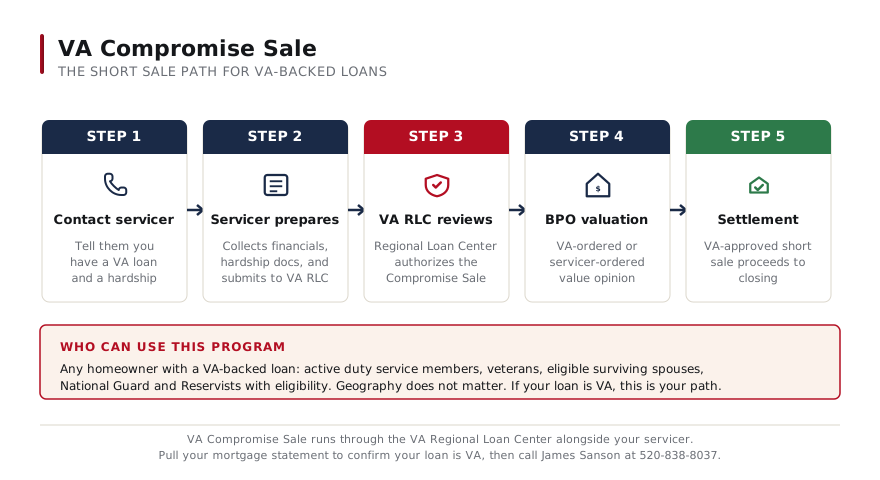
A VA Compromise Sale typically follows this sequence:

  1. Initial consultation with an experienced agent. Confirm that a Compromise Sale fits your situation and that the home is positioned to sell.
  2. Listing the property. The home is listed at a realistic market price based on a comparative market analysis.
  3. Buyer's offer received. A buyer makes an offer that you, as the listing seller, accept.
  4. Compromise Sale package submitted to the servicer. The accepted offer, your hardship documentation, financial summary, and the listing details are packaged for the servicer.
  5. Servicer reviews and submits to the VA. The servicer evaluates the package and submits it to the VA for review.
  6. VA reviews and authorizes the Compromise Sale terms. The VA may request additional information or order its own property valuation.
  7. Approval letter issued. The approval terms are documented, including the specific deficiency treatment, any seller contribution requirements, and conditions of closing.
  8. Closing. The sale closes per the approval terms, typically 30 to 45 days after approval.

Total time from listing to closing is typically 60 to 120 days, sometimes longer if VA review takes additional time or if property valuation issues arise. This is generally faster than equivalent FHA Pre-Foreclosure Sales because of the VA's more standardized review process.

VA entitlement and what happens to it

This is one of the most important questions veterans ask, and it deserves direct attention. VA loan entitlement is the amount of VA backing you can use on VA loans, and a Compromise Sale typically involves a partial loss against that entitlement.

How the entitlement question works in general terms:

  1. VA entitlement is a finite resource. Each eligible veteran has a basic entitlement amount and, for higher loan amounts, a bonus or second-tier entitlement.
  2. A Compromise Sale typically involves a partial loss. The VA pays the servicer a backing amount tied to the loan's loss. That backing amount counts against your future VA loan eligibility until certain conditions are met.
  3. Restoration of entitlement is possible. In some cases, veterans can restore lost entitlement by repaying the VA for its loss after the Compromise Sale closes. The specific rules vary and are administered directly by the VA.
  4. Future VA loan eligibility may be affected. The amount of your remaining entitlement determines how much you can borrow on a future VA loan with zero down payment. Partial loss of entitlement may still allow a future VA loan, but with different terms.

The specifics of your entitlement situation depend on your service record, the original loan terms, and current VA guidelines. This is genuinely a VA loan officer question, not a real estate agent question. Before completing a Compromise Sale, speak with a VA-trained mortgage loan officer about your specific entitlement implications. The James Sanson Team is happy to refer you to a loan officer experienced with VA entitlement matters; call 520-838-8037 if you need one. They can pull your VA Certificate of Eligibility, calculate your remaining entitlement before and after the sale, and help you plan for any future VA loan you might want to pursue.

Deficiency and the VA's role

One of the practical advantages of the VA Compromise Sale framework is how deficiency is typically handled. Unlike conventional short sales, where deficiency waiver depends on the specific approval letter and lender willingness, the VA's framework typically addresses deficiency directly:

  1. The VA pays the servicer for the loss on the loan. This is the "compromise" the VA agrees to. The servicer receives payment from the VA for the difference between the sale proceeds and the loan balance (up to the VA's backing amount).
  2. The veteran is typically released from further obligation to the servicer. Once the Compromise Sale closes and the VA's payment is processed, the borrower is generally released from the original mortgage obligation.
  3. The VA may pursue restoration. In some cases, the VA may seek to recover its loss from the veteran, though this is not automatic and varies by case.

The specific treatment of the deficiency for your Compromise Sale will be documented in the approval letter. Arizona's anti-deficiency statutes (A.R.S. § 33-814 and § 33-729) may also provide additional protection for certain residential properties, though the analysis is fact-specific. For legal questions about deficiency and your specific loan, consult an Arizona-licensed attorney.

Active duty protections (SCRA)

If you are currently on active duty (or recently transitioned from active duty), the Servicemembers Civil Relief Act (SCRA) provides specific protections that affect mortgage proceedings, including:

  1. Interest rate caps. SCRA generally caps mortgage interest rates at 6 percent for loans originated before active-duty service when the service materially affects the ability to pay.
  2. Foreclosure protections. SCRA generally prohibits non-judicial foreclosure on properties owned by service members during active duty and for a period afterward, without a court order.
  3. Eviction protections. Service members and their dependents may be protected from eviction without a court order.
  4. Stay of proceedings. Service members may request a court stay of civil proceedings, including mortgage-related actions, when active duty affects their ability to participate.

SCRA protections are real and meaningful, but they require proper notification and documentation. If you are on active duty and facing mortgage hardship, talk to a JAG (Judge Advocate General) attorney or a civilian attorney experienced with SCRA before making any decisions about a Compromise Sale, foreclosure, or other resolution. The protections are not automatic; you have to invoke them.

The James Sanson Team is not legal counsel. For SCRA-related legal questions, consult a JAG attorney through your unit or a civilian Arizona attorney with SCRA experience.

Requalifying for a new VA loan

For many veterans, the question after a Compromise Sale is: when can I use my VA loan benefit again? The general framework:

  1. Generally, about 2 years. VA generally requires a 2-year waiting period after a short sale or Compromise Sale, foreclosure, or deed in lieu, subject to current VA guidelines and lender overlays. The VA tends to treat these events similarly for seasoning purposes, whereas conventional loan programs have a more pronounced gap between event types. Current VA guidelines should be confirmed at the time you are ready to apply.
  2. Extenuating circumstances may shorten this. If your hardship was demonstrably outside your control (death of a co-borrower, serious illness, military relocation), the VA may allow a shorter wait.
  3. Remaining entitlement determines what you can borrow. Even after the waiting period, the amount of VA entitlement remaining (which may be reduced by the Compromise Sale loss) affects the size of your future VA loan.
  4. Credit recovery matters. The Compromise Sale and the missed payments leading up to it cause damage to credit. Rebuilding credit during the waiting period strengthens your future application. See credit consequences of a short sale for more on the credit recovery path.

When you are ready to apply for a new VA loan, work with a VA-trained mortgage loan officer who can pull your current Certificate of Eligibility, verify remaining entitlement, and walk you through the application. The 2-year framework is general guidance; your specific situation depends on current VA rules and your credit profile at the time of application.

Compromise Sale vs other VA options

Before pursuing a Compromise Sale, it is worth understanding the other options the VA offers for borrowers in hardship:

  1. Repayment plan. If the hardship is short-term and you can resume regular payments, the servicer may set up a plan to repay missed amounts over a defined period.
  2. Special forbearance. Temporary pause or reduction of payments for a defined period, with the missed amount addressed at the end.
  3. Loan modification. Permanent restructuring of the loan terms to produce a payment you can afford long-term.
  4. VA refunding. In some cases, the VA may purchase the loan from the servicer and work directly with the veteran on a resolution. This is rare but available in specific circumstances.
  5. Deed in lieu. Voluntary transfer of the property deed to the lender in exchange for release from the mortgage. The VA's framework supports this in some circumstances.
  6. Compromise Sale. The path described on this page is not realistic when keeping the home.

The right option depends on your specific situation. A VA-trained loan officer, your servicer's loss mitigation department, and a HUD-approved housing counselor can each help you evaluate which fits. For more on these tradeoffs, see the general short sale process for the underlying mechanics, and the short sale process by loan type to see how other loan types compare. If your loan involves a second mortgage or HELOC, that adds complexity to the discussion of short sales with junior liens.

Important.This page describes the VA Compromise Sale framework in general terms for Maricopa veterans. Specific eligibility, entitlement implications, deficiency treatment, and waiting periods depend on current VA guidelines (which are updated periodically), your service history, and your specific loan terms. For VA-specific questions, consult a VA-trained mortgage loan officer or contact the VA directly at theVA Home Loans portal. For SCRA-related legal questions, consult a JAG attorney or civilian attorney with SCRA experience. For free, neutral mortgage assistance counseling, contact a HUD-approved housing counselor at hud.gov. The James Sanson Team is not affiliated with the Department of Veterans Affairs or any federal agency and does not provide legal, tax, or VA entitlement advice. No specific outcome can be promised.

The James Sanson Team has handled many VA Compromise Sales for Maricopa veterans, and we treat each one with the seriousness it deserves. Call 520-838-8037 to talk through your specific situation, with no obligation. We will be honest about whether a Compromise Sale fits your circumstances and refer you to a VA-trained loan officer for entitlement questions or to other professionals when a different path makes more sense. To compare with other loan types, see the FHA short sale process or the conventional short sale process. The Maricopa short sale team has over two decades of experience helping Arizona veterans through housing hardship.

Tell us about your situation

No pressure, no obligation, no charge. James will call you back personally to discuss your options. For faster help, call 520-838-8037.

Before you submit

You may stop doing business with us at any time. You may accept or reject the offer of mortgage assistance we obtain from your lender. If you reject the offer, you do not have to pay us. If you accept the offer, you will pay us based on the agreed listing terms.

The James Sanson Team is not associated with the government, and our service is not approved by the government or your lender.

Even if you accept this offer and use our service, your lender may not agree to change your loan.

James Sanson | Real Broker LLC | Licensed in Arizona

Conversations are confidential and carry no obligation. Not legal, tax, or financial advice. For impartial mortgage assistance counseling, contact a HUD-approved housing counselor at hud.gov.

Licensed since August 2002 Maricopa focus since 2004 Short sale experience since 2008 FastExpert 2026 Top Agent

Frequently asked questions

Is a VA Compromise Sale the same as a short sale?
Functionally, yes, with a VA-specific framework. The Department of Veterans Affairs uses "Compromise Sale" as its formal term because the VA is technically compromising the amount owed under its backing. The practical experience for the borrower is similar to a conventional short sale: the home sells for less than the loan balance, the lender and the VA accept the resolution, and the borrower is released from further obligation per the approval terms. The differences are in approval authority (VA reviews directly) and downstream implications (entitlement).
Will I lose my VA loan eligibility after a Compromise Sale?
Not necessarily completely. A Compromise Sale typically involves a partial loss against your VA entitlement, but you generally do not lose VA eligibility entirely. Restoration of full entitlement may be possible by repaying the VA's loss after the sale closes. Whether you can use a VA loan again depends on your remaining entitlement, the waiting period (typically about 2 years), and your credit profile at the time of application. Talk to a VA-trained mortgage loan officer about your specific situation.
How long does a VA Compromise Sale take?
Typically 60 to 120 days from listing to closing, sometimes longer if VA review takes additional time. This is generally faster than equivalent FHA Pre-Foreclosure Sales because of the VA's more standardized review process. Timeline depends on how quickly an acceptable offer is received, how fast the servicer processes the package, and the VA's review time.
Can I do a Compromise Sale if I'm on active duty?
Yes, in many cases. Active duty service members can pursue Compromise Sales, but the Servicemembers Civil Relief Act (SCRA) provides additional protections that affect your situation. If you are on active duty, talk to a JAG attorney or civilian attorney experienced with SCRA before proceeding. SCRA protections are not automatic; they require proper invocation. The combination of active-duty status and a Compromise Sale has specific implications that warrant legal review.
Does the VA charge me anything for a Compromise Sale?
Typically no out-of-pocket cost. Closing costs and any required deficiency are generally paid from the sale proceeds, with the VA and the servicer accepting the net amount as resolution. The VA may, in some cases, seek to recover its loss from the veteran after the sale (the "compromise" payment becomes a debt the VA may pursue), though this is not automatic. Specific terms appear in the approval letter and should be reviewed carefully.
What if my servicer is not cooperating with my Compromise Sale request?
Servicer performance varies. If you are not getting traction, options include: requesting escalation to a supervisor within the servicer, contacting the VA directly at the regional loan center for your area, working with a HUD-approved housing counselor who can advocate on your behalf, or filing a complaint with the VA or the Consumer Financial Protection Bureau. The VA takes servicer non-cooperation seriously when a Compromise Sale is the appropriate path.
Can The James Sanson Team handle my VA Compromise Sale?
Yes. We have handled many VA Compromise Sales for Maricopa veterans since 2004. We are familiar with the documentation, the servicer relationships, and the VA review process. We work alongside your VA-trained mortgage loan officer for the entitlement questions and refer to other professionals as needed. We are not affiliated with the VA itself; the VA does not designate or endorse real estate agents. We simply have experience with the process.

Talk to a Maricopa specialist today

Whether you're buying, selling, or just exploring, call us. No obligation.

520-838-8037

James Sanson | Real Broker LLC | Licensed in Arizona

Talk to a Maricopa short sale specialist

Call 520-838-8037 right now, or fill out the form and we will reach out within one business day.

Before you submit

You may stop doing business with us at any time. You may accept or reject the offer of mortgage assistance we obtain from your lender. If you reject the offer, you do not have to pay us. If you accept the offer, you will pay us based on the agreed listing terms.

The James Sanson Team is not associated with the government, and our service is not approved by the government or your lender.

Even if you accept this offer and use our service, your lender may not agree to change your loan.

James Sanson | Real Broker LLC | Licensed in Arizona

Conversations are confidential and carry no obligation. Not legal, tax, or financial advice. For impartial mortgage assistance counseling, contact a HUD-approved housing counselor at hud.gov.