

James Sanson
Lead Short Sale Negotiator
Licensed since August 2002, Maricopa focus since 2004. Handles every short sale on this site personally.
Lead Short Sale Negotiator
Licensed since August 2002, Maricopa focus since 2004. Handles every short sale on this site personally.

Buyer Specialist
7 years in Maricopa. Works with buyers writing offers on our short sale listings. Patient, thorough, answers the phone.

Bilingual Buyer Specialist
Habla espanol. 8 years experience. Works with buyers across 85138 and 85139 on our short sale listings.
Why the second lien holder has separate veto power, what they typically ask for, and the workarounds we use to keep deals together.
Real Broker LLC · Licensed in Arizona
A short sale with a second mortgage, HELOC, or other junior lien is meaningfully harder than a single-lien short sale. The senior lender and every junior lienholder must agree to release their liens for the sale to close. Junior lienholders typically receive a small portion of the sale proceeds (often a few thousand dollars) in exchange for releasing their lien, but they can also refuse to participate, demand more, or pursue the borrower separately for the deficiency. The senior lender often will not approve unless the junior is also resolved. Most successful short sales with multiple liens require experienced negotiation. Call 520-838-8037 to discuss your specific situation.
If your Maricopa home has more than one mortgage or other lien against it, your short sale is fundamentally more complex than a single-lien transaction. Every additional lien adds another negotiation, another approval requirement, and another path for the deal to fall apart. This page covers what junior liens are, how short sale negotiations work when they are present, and what to watch for in deficiency treatment.
The James Sanson Team has handled short sales with second mortgages, HELOCs, judgment liens, and tax liens for Maricopa homeowners since 2004. The complexity is real, and so is the path through it. Call 520-838-8037 to talk through your specific situation, with no obligation. For legal questions about lien priority and deficiency exposure on specific junior liens, consult an Arizona-licensed attorney.
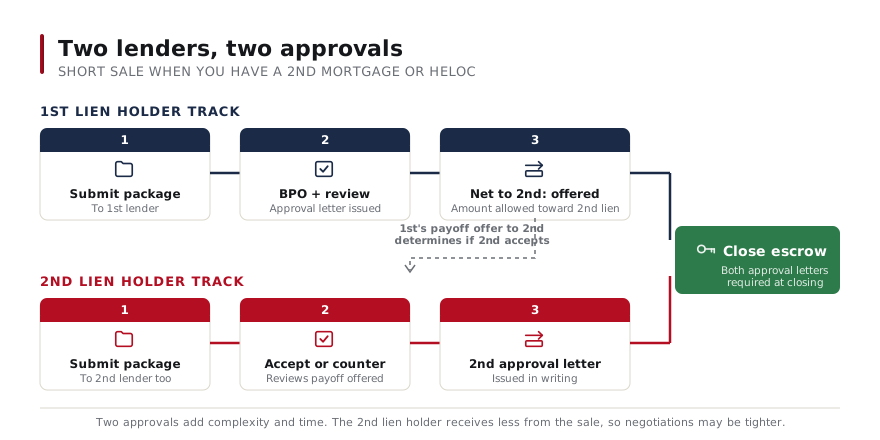
A short sale needs every lien against the property to be released for the sale to close with a clear title. In a single-lien short sale, this is straightforward: the senior lender agrees to accept less than the full balance and releases its lien. Done. In a multi-lien short sale, every lien must be addressed:
The practical implication: a multi-lien short sale requires an agent who knows how to handle all lien negotiations in parallel, not just sell the home. The negotiation matters more than the listing in these transactions.
Several different kinds of liens can sit behind the senior mortgage. Each has its own typical handling:
A closed-end loan secured by the property, typically taken out at the same time as the first mortgage (80/20 or 80/10/10 structure from the original purchase) or as a separate, later transaction. Common uses include avoiding mortgage insurance, financing a higher purchase price, or accessing equity for a specific purpose.
An open line of credit secured by the property. Unlike a closed-end second mortgage, a HELOC can be drawn, repaid, and redrawn over its lifetime. Even with a zero balance, the open line creates a lien that must be addressed before the property can be sold with a clear title.
A closed-end loan is typically used to access existing equity. Functions like a second mortgage but originated separately from the original purchase loan.
If you have fallen behind on HOA dues, your homeowners' association may have recorded a lien against the property. HOA liens have specific Arizona statutory treatment and can complicate sales when arrears are significant.
If a creditor has obtained a court judgment against you and recorded it against your property, the judgment becomes a lien. Common sources include unpaid medical debts, credit card judgments, business debts, and prior litigation.
Federal IRS liens, state tax liens, or unpaid property tax liens can also attach to the property. Tax liens often take priority over other lien types, complicating the priority hierarchy.
If a contractor or supplier was not paid for work on the property, they may have recorded a mechanic's lien. These are time-limited but enforceable while active.
If you are not sure what liens exist on your property beyond your mortgages, a title search through a title company will produce a definitive list, typically for $100 to $200. This is worth doing before starting any short sale that may involve junior liens.
A multi-lien short sale runs roughly in this sequence:
This is materially more work than a single-lien short sale. Each additional lien typically adds weeks to the timeline.
When a short sale closes with multiple liens, the proceeds are typically allocated in a defined priority order:
The senior lender has authority over the allocation in most cases. Its approval letter typically caps the maximum allocation to junior lienholders. If a junior demands more than the senior will allow, the deal needs additional adjustment, or it falls apart.
This allocation framework is one reason junior lienholders sometimes feel poorly served by short sales. They are positioned to receive far less than their actual loan balance, often with limited recourse against the senior's authority to set the allocation. They may push back, demand more, or refuse to participate.
Sometimes a junior lienholder will not agree to release its lien for the allocation the senior is offering. Common reasons:
When a junior refuses to release, the realistic alternatives include: additional negotiation to reach an agreement; a buyer-side contribution toward the junior; a deed in lieu (if available with the senior and feasible despite junior liens, which is hard); or allowing the property to go to foreclosure. None of these is simple. The negotiation work to bring a junior to an agreement is often the hardest part of a multi-lien short sale.
If a junior lienholder is genuinely refusing all reasonable terms, an Arizona-licensed attorney experienced with debt negotiation can sometimes find solutions that a Realtor cannot. The James Sanson Team works with attorneys when these situations arise.
This is one of the most important things to understand about multi-lien short sales: the senior's deficiency waiver does not bind the junior.
What this means in practice:
Arizona anti-deficiency statutes (A.R.S. § 33-814 and § 33-729) may provide some protection for certain residential properties, but the analysis is fact-specific and varies by lien type. Junior liens used for non-purchase-money purposes (HELOCs used to consolidate other debt, second mortgages taken out years after purchase to access equity) may not have the same statutory protection as purchase-money first mortgages.
The practical takeaway: in any multi-lien short sale, do not assume the senior's approval terms protect you from the junior. Read every approval letter carefully, get explicit junior deficiency treatment in writing, and consider having any junior agreement reviewed by an Arizona-licensed attorney before signing.
HELOCs introduce some specific complications that closed-end second mortgages do not:
If your situation involves a HELOC, particularly one with significant variable-rate exposure or unusual subordination history, the negotiation typically requires more attention than a closed-end second mortgage. An experienced agent and, if needed, an Arizona-licensed attorney can navigate the specifics.
Several decisions matter strategically in a multi-lien short sale:
If you are sitting on a multi-lien situation and are not sure where to start, call 520-838-8037 for a confidential conversation. We can help you understand how each lien affects your specific situation before any commitments are made.
For the underlying short sale mechanics common to all situations, see the underlying short sale mechanics. For loan-type-specific frameworks under which the senior lien might fall, see VA loan short sales, FHA Pre-Foreclosure Sales, Fannie Mae or Freddie Mac loans, or the USDA short sale process. The junior lien framework on this page layers on top of any of those senior loan types.
Important.This page describes, in general terms, short sales involving second mortgages, HELOCs, and other junior liens for Maricopa homeowners. Specific lien priority, deficiency exposure, and resolution paths depend on the type of each lien, the original loan purpose, the lender's policies, the senior lender's approval terms, and current Arizona law. For legal questions about lien priority, deficiency, or your specific liens, consult an Arizona-licensed attorney. For tax questions about forgiven debt, consult a CPA. For free, neutral mortgage assistance counseling, contact a HUD-approved housing counselor at the HUD counselor directory. The James Sanson Team does not provide legal or tax advice. No specific outcome can be promised.
If your Maricopa home has a second mortgage, HELOC, or other junior lien and you are considering a short sale, call 520-838-8037 to talk through your specific situation. We will help you understand how each lien adds to the complexity and refer you to attorneys or counselors whose expertise is needed. The negotiation work is real, but it is also doable with the right approach. For a broader context on how loan type affects the short sale framework, see loan-type-specific short sale guidance. The Maricopa short sale team has navigated multi-lien short sales for over two decades.
No pressure, no obligation, no charge. James will call you back personally to discuss your options. For faster help, call 520-838-8037.
Whether you're buying, selling, or just exploring, call us. No obligation.
520-838-8037James Sanson | Real Broker LLC | Licensed in Arizona
Call 520-838-8037 right now, or fill out the form and we will reach out within one business day.