

James Sanson
Lead Short Sale Negotiator
Licensed since August 2002, Maricopa focus since 2004. Handles every short sale on this site personally.
Lead Short Sale Negotiator
Licensed since August 2002, Maricopa focus since 2004. Handles every short sale on this site personally.

Buyer Specialist
7 years in Maricopa. Works with buyers writing offers on our short sale listings. Patient, thorough, answers the phone.

Bilingual Buyer Specialist
Habla espanol. 8 years experience. Works with buyers across 85138 and 85139 on our short sale listings.
The three flavors of conventional loans, how to find out which one you have, and how the short sale process differs across each.
Real Broker LLC · Licensed in Arizona
A conventional short sale is one done on a non-government-backed mortgage, typically owned or backed by Fannie Mae, Freddie Mac, or a private investor (a portfolio loan). Unlike VA Compromise Sales or FHA Pre-Foreclosure Sales, conventional short sales do not operate under a single-agency framework. The servicer follows the applicable Fannie or Freddie servicing guide (or the private investor's own policy). This makes the process more flexible than government programs but also more variable from servicer to servicer. Waiting periods to qualify for a new conventional loan typically run 2 to 4 years after a short sale, subject to down payment, circumstances, and current Fannie or Freddie guidelines. Call 520-838-8037 to discuss your specific situation.
If your Maricopa home is financed with a conventional mortgage and you are facing financial hardship, the short sale process you will go through looks different from a VA Compromise Sale or an FHA Pre-Foreclosure Sale. The conventional path is more variable, more servicer-driven, and (in some cases) more flexible than the government program frameworks. Understanding what "conventional" actually means and which subcategory your loan falls into helps you set realistic expectations.
This page walks through how conventional short sales work in practice. The James Sanson Team has handled conventional short sales for Maricopa homeowners since 2004, across Fannie Mae, Freddie Mac, and various portfolio investors. Call 520-838-8037 to talk through your specific situation, with no obligation.
"Conventional" is the catch-all term for any mortgage that is not government-backed. That means anything not insured by the FHA, not backed by the VA, and not under the USDA Rural Development program. The vast majority of mortgages in the United States are conventional, though within that category, there are meaningful subdivisions.
The defining characteristic of conventional loans for short-sale purposes is that no single federal agency sets the rules. Instead, the rules come from whoever owns or controls the loan after origination:
For your short sale, knowing which of these owns your specific loan determines which set of rules the servicer will follow.
Loans owned or backed by Fannie Mae follow the Fannie Mae Servicing Guide. The guide is publicly available at Fannie Mae's Single Family portal and is updated periodically. Fannie Mae short sales typically follow a defined documentation framework, with the servicer applying Fannie's rules during loss mitigation review.
Characteristics of Fannie Mae short sales:
Loans owned or backed by Freddie Mac follow the Freddie Mac Servicing Guide. The guide is available at Freddie Mac's Single Family portal. The framework is broadly similar to Fannie Mae's, but with some distinct differences in documentation and decision trees.
Characteristics of Freddie Mac short sales:
Some conventional loans are owned by private investors rather than Fannie Mae or Freddie Mac. These are typically called portfolio loans because the originating lender or a private investor holds them in their own portfolio rather than selling them to Fannie or Freddie. Common examples include:
Portfolio short sales follow the investor's internal policy rather than Fannie or Freddie guidelines. This can mean more flexibility (private investors can sometimes make case-specific decisions faster than the agency framework allows) or more rigidity (some private investors have stricter documentation requirements or higher minimum recovery expectations). The answer depends on which specific investor owns your loan.
Knowing who owns your loan is helpful before starting a conventional short sale. Several ways to find out:
If neither Fannie nor Freddie owns your loan, it is almost certainly a portfolio loan held by a private investor or the originating lender. In that case, the servicer is your primary source of information about the specific rules that apply.
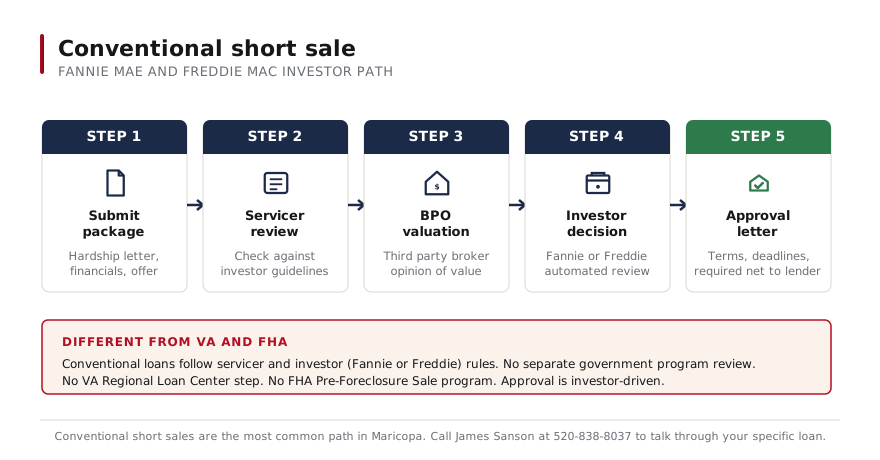
A conventional short sale typically follows this general sequence regardless of who owns the loan:
Total time from listing to closing typically runs 90 to 180 days for a conventional short sale. This is generally faster than an FHA Pre-Foreclosure Sale (which has a defined marketing period), but the timeline varies by servicer and investor. For the underlying short-sale mechanics common to all loan types, see how the short-sale process works.
One of the practical realities of conventional short sales is that the flexibility comes with variability. This is true in both directions:
Where flexibility helps:
Where variability hurts:
The practical implication: an experienced agent who has worked with multiple servicers and investors is more useful for conventional short sales than for the more structured government programs. Familiarity with how specific servicers operate (Chase, Wells Fargo, Mr. Cooper, PHH, Carrington, NewRez, and dozens of others) can shave weeks off the timeline.
For Fannie Mae and Freddie Mac conventional short sales, the standard approach is to include a deficiency waiver in the approval letter. The lender accepts the sale proceeds as full satisfaction of the loan with no further pursuit of the unpaid balance. This is the most common outcome for Fannie and Freddie loans.
For portfolio loans, deficiency treatment varies by investor. Some include automatic deficiency waivers; others reserve the right to pursue the unpaid balance. The approval letter documents this, and the specific terms should be reviewed carefully before closing.
Arizona's anti-deficiency statutes (A.R.S. § 33-814 and § 33-729) may also provide additional protection for certain residential properties, though the analysis is fact-specific. For legal questions about a deficiency on a specific loan, consult an Arizona-licensed attorney. For an overview of credit consequences common across loan types, see the credit impact of a short sale.
The waiting period to qualify for a new conventional mortgage after a short sale depends on the loan program at application time (Fannie or Freddie) and your specific circumstances:
For your specific situation, when you are ready to apply, speak with a licensed Arizona mortgage loan officer who can check current Fannie and Freddie seasoning requirements and screen lenders with the most favorable overlays for your profile.
Several recurring issues affect conventional short sales:
The James Sanson Team has handled conventional short sales across many servicers and investors. Call 520-838-8037 to talk through your specific situation.
Important.This page describes conventional short sales in general terms for Maricopa homeowners. Specific eligibility, documentation requirements, deficiency treatment, and waiting periods depend on current Fannie Mae and Freddie Mac servicing guides (updated periodically), individual lender overlays, and the specific terms of your loan. For questions about your specific loan, contact your servicer's loss mitigation department or a HUD-approved housing counselor at the HUD counselor directory. For legal questions about deficiency or your specific loan terms, consult an Arizona-licensed attorney. For tax questions about forgiven debt, consult a CPA. The James Sanson Team is not affiliated with Fannie Mae, Freddie Mac, or any federal agency. No specific outcome can be promised.
If your Maricopa home has a conventional mortgage and you are facing hardship, call 520-838-8037 to talk through whether a short sale fits your situation. We will identify your loan owner (Fannie, Freddie, or portfolio), explain how the process will work for your specific servicer, and refer you to other professionals as needed. To compare with other loan types, see the VA Compromise Sale framework, the FHA Pre-Foreclosure Sale program, or the USDA short sale process. If your loan involves a second mortgage or HELOC, additional complexity applies, as discussed in the context of short sales with junior liens. For the broader silo context, see the comparing short sale processes by loan program. Our Maricopa short sale team has handled conventional short sales across many servicers and investors since 2004.
No pressure, no obligation, no charge. James will call you back personally to discuss your options. For faster help, call 520-838-8037.
Whether you're buying, selling, or just exploring, call us. No obligation.
520-838-8037James Sanson | Real Broker LLC | Licensed in Arizona
Call 520-838-8037 right now, or fill out the form and we will reach out within one business day.