

1,000+ Closings 267 Five-Star Reviews FastExpert 2026 Top Agent
James Sanson, REALTOR

James Sanson

Lead Short Sale Negotiator

Licensed since August 2002, Maricopa focus since 2004. Handles every short sale on this site personally.

David Hoos, REALTOR

David Hoos

Buyer Specialist

7 years in Maricopa. Works with buyers writing offers on our short sale listings. Patient, thorough, answers the phone.

David Ruiz, REALTOR

David Ruiz

Bilingual Buyer Specialist

Habla espanol. 8 years experience. Works with buyers across 85138 and 85139 on our short sale listings.

USDA Loan Short Sale in Maricopa: How Rural Development Handles It

How USDA's short sale workflow differs from FHA and conventional, including the documentation USDA specifically requires from Maricopa homeowners.

Real Broker LLC · Licensed in Arizona

By James Sanson, REALTOR. Licensed Arizona REALTOR since August 2002. Maricopa specialist since 2004. 1,000+ closings. Seethe team's short sale credentials.
Published May 16, 2026 · Updated May 16, 2026
Quick answer

A USDA short sale is the resolution path for borrowers with a USDA Rural Development mortgage facing financial hardship. Like other federally-backed loans, USDA short sales require agency review in addition to servicer approval. USDA Rural Development sets the framework, and the rules differ slightly between USDA-backed loans (where a private lender originated the mortgage with USDA support, also called Section 502 of USDA's guarantee program) and USDA Direct loans (where USDA itself is the lender, also called Section 502 Direct). Most USDA short sales involve approximately a 3-year wait before qualifying for a new USDA loan, subject to current USDA guidelines and lender overlays. Call 520-838-8037 to discuss your specific situation, or contact a HUD-approved housing counselor for free through the HUD counselor directory.

If your Maricopa home is financed with a USDA Rural Development mortgage and you are facing financial hardship, the short sale process follows a USDA-specific framework rather than the conventional or FHA paths. USDA short sales are less common than other loan types, so fewer agents have direct experience with them, and there is less program-specific content online. This page covers what a USDA short sale entails and how the process works for Maricopa homeowners.

The James Sanson Team has handled USDA short sales as part of our broader Maricopa short sale practice since 2004. The official USDA Rural Development framework is documented at the USDA Rural Development site. For your specific situation, call 520-838-8037 or contact a free HUD-approved housing counselor at the HUD counselor directory.
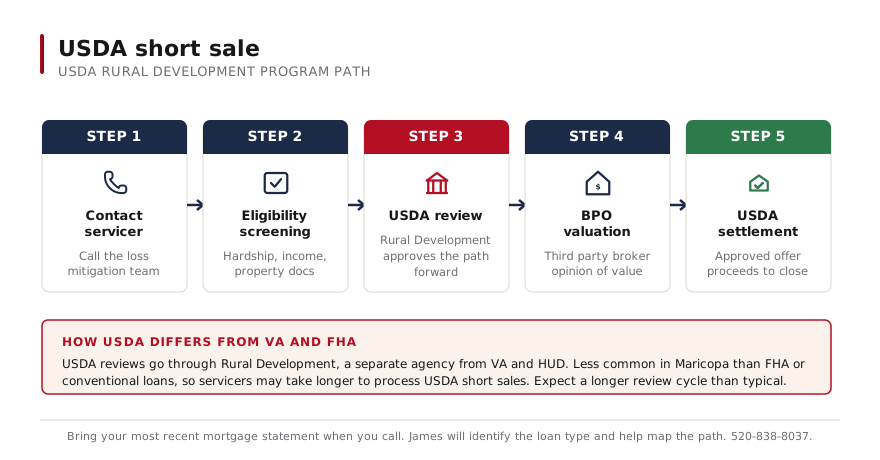
Five step USDA Rural Development short sale flow: contact servicer, eligibility screening, USDA Rural Development review, BPO valuation, USDA-approved settlement. Callout explains how USDA differs from FHA and VA
The five step USDA Rural Development short sale path. Distinct agency review on top of standard servicer steps.

What a USDA short sale is

A USDA short sale follows the same general framework as other short sales (a home sold for less than the loan balance, with lender and agency approval, and the borrower generally released from further obligations per the approval terms), but operates under USDA Rural Development's specific rules. Key characteristics:

  1. USDA approval is generally required. Similar to VA Compromise Sales, USDA-backed loans typically require agency review in addition to servicer approval. The servicer handles day-to-day administration, but USDA itself authorizes the sale terms.
  2. Standardized framework, less common in practice. Because USDA short sales happen less frequently than conventional or FHA short sales, the rules are standardized, but practical experience varies widely among real estate agents and servicers.
  3. Hardship documentation is required. USDA looks for documented financial hardship similar to other federal loan programs (job loss, medical, divorce, death of co-borrower, business decline).
  4. Two loan flavors with slightly different processes. USDA-backed loans (Section 502 with USDA support) and USDA Direct loans (Section 502 Direct) follow different administrative paths, even within the same general framework.

Two types: USDA-backed vs Direct

USDA Rural Development administers two distinct loan programs for single-family homes, and the short-sale process differs in some respects between them.

USDA-backed loans (Section 502 with USDA support)

The more common type. A private lender (bank, credit union, or mortgage company) originated the loan, and USDA provides backing through its guarantee program. The borrower makes payments to the lender or its servicer, just like any other mortgage. USDA's role is to back the loan against loss.

Short sale characteristics for USDA-backed loans:

  1. The servicer handles the initial loss mitigation review
  2. USDA Rural Development reviews and authorizes the short sale per agency guidelines
  3. Documentation is submitted through the servicer using USDA-specified forms
  4. The approval process is broadly similar to the FHA's PFS program, but with different specifics

USDA Direct loans (Section 502 Direct)

Less common. USDA Rural Development itself is the lender. The borrower makes payments directly to USDA. Direct loans are typically for lower-income borrowers and may include features like subsidized interest rates.

Short sale characteristics for Direct loans:

  1. USDA serves as both servicer and investor
  2. The short sale review goes through USDA Rural Development directly
  3. Communication is with USDA staff rather than a private servicer
  4. Timelines and documentation can differ from the USDA-backed program

If you are not sure which type of USDA loan you have, check your mortgage statement (it typically identifies the program), look at your closing documents, or call your mortgage payment recipient to ask. The distinction matters because the practical communication paths differ.

USDA loans in Maricopa specifically

Maricopa, despite its proximity to Phoenix, has historically had areas that qualified for USDA Rural Development financing. The USDA eligibility map (which determines where USDA loans can be used) is periodically updated, and the designation of specific areas as "rural" for USDA purposes can change over time. Some Maricopa addresses that were USDA-eligible when the loan was originated may no longer be eligible for new USDA loans, but the existing USDA loan remains under USDA's framework.

For homeowners with USDA loans in Maricopa, the short sale framework is the same regardless of whether the area is currently mapped as USDA-eligible. Once the loan is in place under USDA, the resolution path follows USDA rules.

The current USDA eligibility map is available at USDA's eligibility tool, which can verify whether a specific address would qualify for a new USDA loan if you are considering one in the future.

Who is eligible

USDA's short sale framework has eligibility criteria that the borrower must meet. The general framework, subject to current USDA Rural Development guidelines:

  1. USDA-backed loan in active status. The mortgage must be a USDA-backed or USDA Direct loan that has not yet reached certain advanced foreclosure milestones.
  2. Documented financial hardship. Job loss, income reduction, medical issues, divorce, death of co-borrower, business decline, or other documented circumstance.
  3. Inability to maintain the mortgage payment. The hardship must result in a real inability to continue paying. Other loss mitigation options (modification, forbearance) typically must be considered first.
  4. Cooperation with the servicer or USDA. Engagement throughout the process. Non-responsive borrowers may be moved toward foreclosure rather than a short sale.
  5. Property condition. The home must be in a condition that allows it to be marketed and sold.

The specific eligibility evaluation is made under current USDA guidelines, which are updated periodically. For your specific situation, talk to your servicer (for USDA-backed loans) or USDA Rural Development directly (for Direct loans), and consider engaging a HUD-approved housing counselor.

How the process works

The typical USDA short sale follows this sequence:

  1. Initial consultation with an experienced agent. Confirm a short sale fits your situation and that USDA's framework applies to your loan.
  2. Loss mitigation application. Submit hardship documentation, financial statements, and a brief written description of the hardship to your servicer (or directly to USDA for Direct loans).
  3. Property valuation. A Broker Price Opinion or appraisal is ordered to establish the current market value.
  4. Listing the property. The home is listed at a realistic market price.
  5. Buyer's offer received. The offer is submitted with the hardship documentation package.
  6. Servicer and USDA review. For USDA-backed loans, the servicer evaluates the package and submits it to the USDA for authorization. For Direct loans, USDA reviews directly.
  7. Approval, counter, or decline. The approval letter documents the specific terms, including the treatment of deficiencies.
  8. Closing. The sale closes per the approval terms, typically 30 to 45 days after approval.

Total time from listing to closing is typically 90 to 180 days, with some variation depending on the USDA's review pace and the servicer's responsiveness. For the short-sale mechanics common to all loan types, see the short-sale process.

Deficiency treatment

USDA short sales typically address a deficiency in the approval letter. For USDA-backed loans, USDA covers the lender's loss up to the program limits, and the borrower is generally released from further obligation per the approval terms. For Direct loans, where USDA itself is the lender, deficiency treatment follows USDA's internal policy.

Key points on deficiency under USDA short sales:

  1. USDA covers the lender's loss on USDA-backed loans, similar to how the VA backs Compromise Sales
  2. The borrower is typically released from further obligation to the servicer once the sale closes, per the approval letter
  3. USDA may pursue recovery in some cases. Like the VA, USDA may seek to recover its loss from the borrower in certain circumstances, though this is not automatic
  4. Arizona anti-deficiency statutes may also apply. A.R.S. § 33-814 and § 33-729 may provide additional protection for certain residential properties

The specific deficiency treatment for your USDA short sale will be documented in the approval letter. Before completing the sale, have the approval letter reviewed carefully, ideally with an Arizona-licensed attorney if there are any questions about the terms.

Requalifying for a new USDA loan

For borrowers who want to use a USDA loan again after a short sale, the general framework:

  1. Generally, approximately 3 years. USDA typically requires a 3-year waiting period after a short sale before qualifying for a new USDA loan, subject to current USDA guidelines and lender overlays.
  2. Shorter waits with extenuating circumstances. If your hardship was demonstrably beyond your control (death of a co-borrower, serious illness, military relocation, business closure), USDA may allow shorter waiting periods under its extenuating circumstances framework.
  3. CAIVRS clearance. Like FHA loans, USDA loan losses are recorded in HUD's Credit Alert Verification Reporting System (CAIVRS). The CAIVRS entry must be cleared or resolved before a new USDA loan can be approved.
  4. Credit recovery matters. The short sale and the missed payments leading up to it cause damage to credit. Rebuilding credit during the waiting period strengthens future applications.
  5. Property eligibility may have changed. Even if you qualify for a new USDA loan, the property you want to buy must be in a currently USDA-eligible area. Maps are updated periodically.

For your specific situation, when you are ready to apply, speak with a licensed Arizona mortgage loan officer experienced with USDA loans who can check current USDA seasoning requirements, pull your CAIVRS status, and verify property eligibility.

Finding an agent with USDA experience

USDA short sales are less common than other loan types, which means finding an agent with direct experience is harder than finding one experienced with conventional or FHA short sales. Things to look for:

  1. Confirmed prior USDA closings. Has the agent actually closed USDA short sales before, or just claimed familiarity?
  2. Understanding the distinction between USDA-backed and direct. An agent who does not know the difference may struggle with the documentation requirements specific to your loan type.
  3. Comfort working directly with USDA staff. For Direct loans, in particular, communication flows through the USDA rather than a private servicer. Some agents have never worked with USDA directly.
  4. Willingness to engage a HUD-approved housing counselor. The free counseling resource is particularly valuable for less common loan types because counselors are familiar with multiple program frameworks.

The James Sanson Team has handled USDA short sales as part of our broader Maricopa short sale practice. We are honest about which loan types we have the deepest experience with and refer to specialists when a particularly unusual situation calls for it. Call 520-838-8037 to talk through your specific situation.

Important.This page describes USDA short sales in general terms for Maricopa homeowners. Specific eligibility, documentation requirements, deficiency treatment, and waiting periods depend on current USDA Rural Development guidelines (which are updated periodically), individual lender overlays, and the specific terms of your loan. For USDA-specific questions, consult a licensed Arizona mortgage loan officer experienced with USDA loans or contact USDA Rural Development directly. For legal questions about deficiency or your specific loan terms, consult an Arizona-licensed attorney. For tax questions about forgiven debt, consult a CPA. For free, neutral mortgage assistance counseling, contact a HUD-approved housing counselor. The James Sanson Team is not affiliated with the USDA or any federal agency. No specific outcome can be promised.

If your Maricopa home is financed with a USDA loan and you are facing hardship, call 520-838-8037 to talk through whether a short sale fits your situation. We will identify your specific USDA loan type, explain how the process will work, and refer you to other professionals as needed. To compare with other loan types, see the VA Compromise Sale process, the FHA Pre-Foreclosure Sale process, or the conventional short sale process. If your USDA loan also has a second lien attached, see short sales involving junior liens for the additional complexity that it introduces. In the broader silo context, return to the short-sale process by loan type. Our Maricopa short sale team has handled USDA short sales since 2004.

Tell us about your situation

No pressure, no obligation, no charge. James will call you back personally to discuss your options. For faster help, call 520-838-8037.

Before you submit

You may stop doing business with us at any time. You may accept or reject the offer of mortgage assistance we obtain from your lender. If you reject the offer, you do not have to pay us. If you accept the offer, you will pay us based on the agreed listing terms.

The James Sanson Team is not associated with the government, and our service is not approved by the government or your lender.

Even if you accept this offer and use our service, your lender may not agree to change your loan.

James Sanson | Real Broker LLC | Licensed in Arizona

Conversations are confidential and carry no obligation. Not legal, tax, or financial advice. For impartial mortgage assistance counseling, contact a HUD-approved housing counselor at hud.gov.

Licensed since August 2002 Maricopa focus since 2004 Short sale experience since 2008 FastExpert 2026 Top Agent

Frequently asked questions

How is a USDA short sale different from an FHA short sale?
Both follow agency-driven frameworks (USDA Rural Development for USDA loans, HUD for FHA loans), but the specific rules and forms differ. FHA's Pre-Foreclosure Sale program has a defined marketing period and standardized minimum offer percentages; USDA's framework is somewhat more flexible but less standardized in public documentation. Both typically have similar 3-year waiting periods to requalify. The practical experience for borrowers is broadly similar, with differences in specific paperwork and decision authority.
Do I have a USDA-backed loan or a USDA Direct loan?
Check your mortgage statement; it typically identifies the program. USDA-backed loans (officially Section 502 of USDA's guarantee program) are the more common type, originated by a private lender (bank, credit union, mortgage company) with USDA support. USDA Direct loans (Section 502 Direct) are made directly by USDA Rural Development to lower-income borrowers. The distinction matters because the communication path differs: USDA-backed loans go through your private servicer first; Direct loans go through USDA directly.
Can I still do a USDA short sale if my Maricopa area no longer qualifies for USDA loans?
Yes. The USDA eligibility map determines where new USDA loans can be used, but once a USDA loan is in place, the resolution path follows USDA rules regardless of whether the area is currently mapped as USDA-eligible. The short sale itself does not require the property to be currently USDA-eligible.
Will the deficiency be waived in a USDA short sale?
Typically yes, with the specifics documented in the approval letter. For USDA-backed loans, USDA covers the lender's loss up to program limits and the borrower is generally released from further obligation. For Direct loans, USDA serves as the lender and the deficiency treatment follows USDA's internal policy. USDA may, in some cases, seek to recover its loss from the borrower, though this is not automatic. Arizona anti-deficiency statutes (A.R.S. § 33-814 and § 33-729) may also provide additional protection for certain residential properties.
How long does a USDA short sale take?
Typically 90 to 180 days from listing to closing, with some variation depending on USDA's review pace and servicer responsiveness. This is generally faster than an FHA Pre-Foreclosure Sale (which has a built-in marketing period), but it varies based on specifics. Direct loan short sales sometimes take longer because the USDA's internal review process can move at the agency's pace rather than the private servicer's.
Can I get a new USDA loan after my short sale?
Generally, yes, after approximately a 3-year wait, subject to current USDA guidelines and lender overlays. You will also need your CAIVRS entry to clear (similar to FHA), and the property you want to buy must be in a currently USDA-eligible area at the time of application. For your specific situation, speak with a licensed Arizona mortgage loan officer experienced with USDA loans.
What if I cannot find a buyer for my USDA home in Maricopa?
If a buyer is not found within a reasonable timeframe, other loss-resolution paths come into play: extended marketing periods (if USDA agrees), loan modification (if the issue is payment affordability), deed in lieu, or allowing the home to go to foreclosure. The cleanest path for most homeowners is a short sale when possible, but it requires a willing buyer at a price USDA will accept. A HUD-approved housing counselor can help evaluate alternatives if the short sale is not working.

Talk to a Maricopa specialist today

Whether you're buying, selling, or just exploring, call us. No obligation.

520-838-8037

James Sanson | Real Broker LLC | Licensed in Arizona

Talk to a Maricopa short sale specialist

Call 520-838-8037 right now, or fill out the form and we will reach out within one business day.

Before you submit

You may stop doing business with us at any time. You may accept or reject the offer of mortgage assistance we obtain from your lender. If you reject the offer, you do not have to pay us. If you accept the offer, you will pay us based on the agreed listing terms.

The James Sanson Team is not associated with the government, and our service is not approved by the government or your lender.

Even if you accept this offer and use our service, your lender may not agree to change your loan.

James Sanson | Real Broker LLC | Licensed in Arizona

Conversations are confidential and carry no obligation. Not legal, tax, or financial advice. For impartial mortgage assistance counseling, contact a HUD-approved housing counselor at hud.gov.